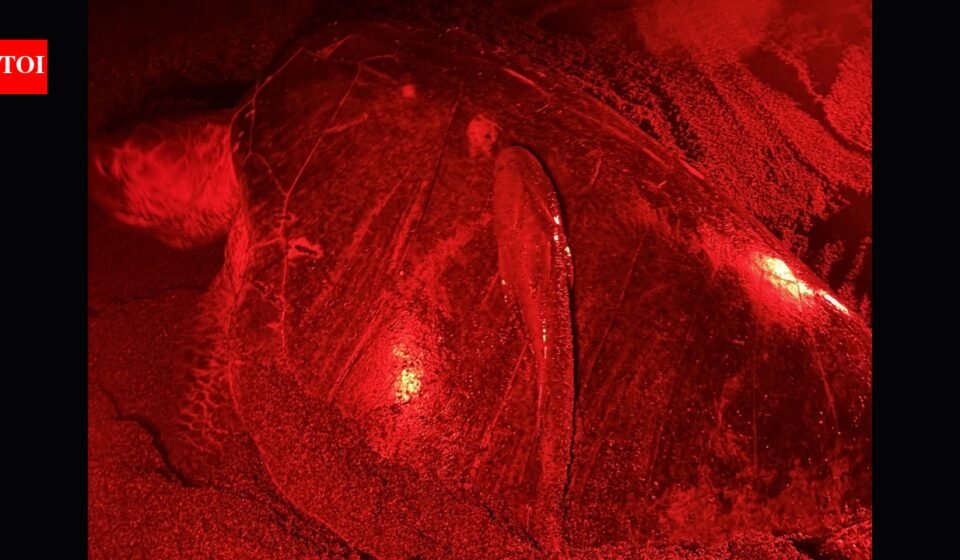
A sea turtle leaves the ocean to lay eggs in Costa Rica with a killifish attached; the fish survives outside the water by holding on for 19 minutes

A mother sea turtle crawls onto a beach in Costa Rica to lay her eggs, bringing with her an unexpected passenger who refuses to let go even after leaving the ocean.A live sucker fish survived in the open air for 19 minutes by clinging to a turtle’s shell with the suckers on its head.This rare encounter took place in September 2025 at Pejeperro Beach.Field staff monitoring nesting sea turtles on the beach spotted olive ridley turtles emerging from the waves with fish clinging to their backs. Sucker fish, also known as loaches, often hitchhike on sharks, rays and turtles in the ocean to save energy, but following their hosts to land is almost unheard of.
Survive out of water
Witnesses on the beach were surprised to see the fish breathing on land.“My colleagues and I were indeed surprised and a bit confused [the remora] Still attached and breathing. ” said Megan Bullock, who observed the encounter with researchers Vicente Peña Eisele and Emily Yeager.Observation records show that the crucian carp remained relatively stationary “during the 19-minute observation period, except for periodically bending its operculum” (gill coverings).The team eventually removed the fish so the turtles’ shells could be measured. When they returned the fish to the sea, it quickly swam away.“As soon as the pomfret returned to the ocean, it began to twist and move quickly away from the researchers, indicating that it was still alive despite being removed from the water for a long time,” the observer noted.Bullock admits she didn’t expect the fish to have so much energy left after living on land.“Nineteen minutes is a really long time out of the water for most fish, so I was definitely surprised,” Bullock said. “What surprised me even more was how energetic the fish was when we removed it from the turtle. For an animal that hadn’t been in the water for a long time, it was struggling violently.”
A rare sight for researchers
Killifish use modified fins on the top of their heads that act as suckers. Hundreds of thousands of sea turtles come ashore each year to lay their eggs, but observers almost never see pompano stay on their journey.“Before I contacted Emily and started researching the topic, I had never heard of a killifish leaving a body of water with its host, let alone one that appeared to be of its own choice,” Bullock said.Even to experienced beach patrol officers, the sight was shocking.“You hear a lot of strange things that happen to your colleagues,” she said, “but this is a rumor I’ve never heard of.”
The mystery of how it survived
How the fish survive being out of the ocean remains a mystery. Most fish suffocate quickly on land because their gills collapse without water flowing through them.“Honestly, we’re not really sure,” Bullock said. “Like most fish, plaice need water running over their gills, and without water, they will suffocate over time.”Bullock wondered whether pomfret could handle low-oxygen conditions better than other fish. Learning more about these unexpected journeys could help scientists better understand how different marine species coexist, which Bullock noted “could help us better protect them.”
The mechanics of a ruthless grip
The secret behind the pomfret’s ability to attach itself to a host on land lies in the evolutionary design of its suckers. This particular organ, located on the top of the fish’s head, is actually a heavily modified dorsal fin. It features a fleshy outer lip that forms a tight seal against a smooth surface area, much like a turtle’s shell, while internal lath-like structures called lamellae create a vacuum when pulled back.In open water, this attachment allows pompano to feed on the host’s remaining food scraps and parasites while conserving vital energy while swimming. Maintaining control over dry land, however, requires overcoming an entirely different set of physical forces. Without the natural buoyancy of the water to support the fish’s weight, gravity creates a constant downward drag.The fact that the suction cups remained secure as the turtle dragged itself through the sand suggests that the seal was very strong and entirely mechanical. The fish requires little active muscle effort to stay locked in place. As long as the outer seal remains moist and intact, the vacuum remains, allowing the hitchhiker to remain attached even during the rough ride across the beach.