Florida scientists used female Burmese pythons as live bait to search for invasive male Burmese pythons in the Everglades, but 3 million camera trap photos detected only 4 pythons

Florida scientists used female Burmese pythons as live bait to search for invasive male Burmese pythons in the Everglades, but only four pythons were detected in 3 million camera trap photos.A study published in the journal Southeastern Naturalist Research shows that placing wild-caught female Burmese pythons (Python bivittatus) in cages in the Everglades ecosystem does not attract wild male pythons.Researchers conducted a 90-day field test at 12 locations, using artificial intelligence software to filter more than 3 million camera trap photos. They recorded only three visits by the pythons to the female-baited cage and one visit to the empty control cage.The study, “Not a fatal attraction: Baiting captive female Burmese pythons does not improve detection of wild pythons,” was led by Alex D. Potash, Maggie Jones, Michael Kirkland, Jenna Cole, Kristen Hart and Robert A. McCleary. This research record is published by the USGS Publications Repository and conducted through the USGS Wetland and Aquatic Research Center.
Captivity stress and chemical signaling
In a controlled laboratory environment, male pythons showed a strong interest in the odors emitted by breeding females. However, scientists believe the stress of living in cages may have prevented captive females from releasing pheromones, thereby removing the chemical scent needed to attract wild males.Understanding how pythons communicate is still limited. The authors note that finding better care methods to reduce stress in captured female snakes could improve future testing, while further research into python chemistry could help create fake scents to track invasive snakes.The failure of the female bait test comes after another setback for scent tracking. In an August 2025 study titled “Mammalian scent bait fails to increase detection of invasive Burmese pythons (Python bivittatus),” published in the journal Biological Invasions Management, researchers tested whether rabbit scent could displace live prey.Authored by Storm Miller, Michael Kirkland, Kristen Hart and Robert A. McCleery of the USGS Wetlands and Aquatic Research Center, the 84-day experiment at 21 sites found only 11 python sightings. Four pythons were found near rabbit scent baits (feces, urine and hair) and seven pythons were found near plain soil. While rabbit scent attracted more native snakes by attracting live mice, it did not attract pythons.
The ongoing battle in the Everglades
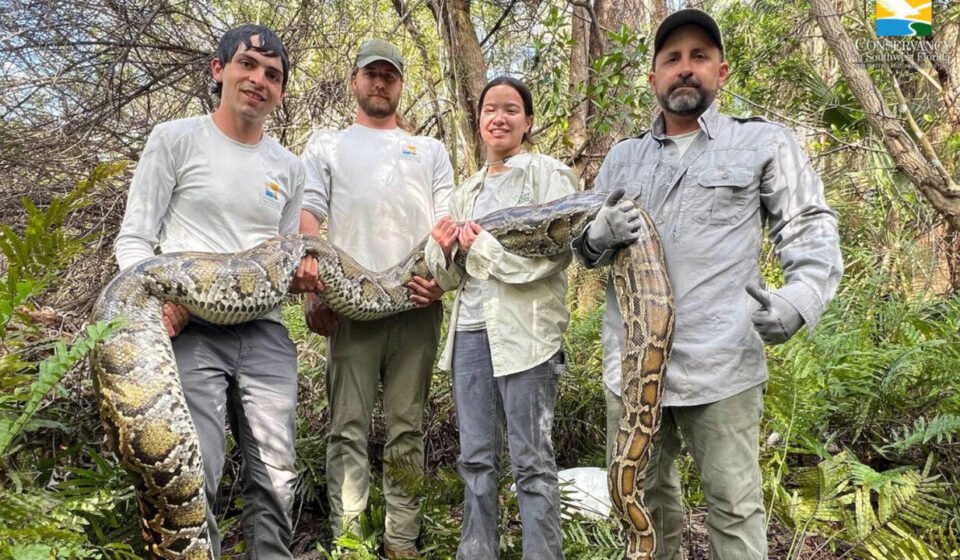
These scent experiments show how difficult it is to find an apex predator that has wiped out native mammals such as swamp rabbits, foxes, raccoons and deer.Pythons spread across South Florida in the 1990s when escaped or released pets entered the wild. Today, tens of thousands of people live in wetlands. Females can lay up to 100 eggs per year, so control efforts are urgent.Despite the challenges of scent lures, state teams and conservation groups report steady progress through hunting and radio tracking.The Conservancy of Southwest Florida recently announced that it has removed 20 tons of pythons from the wild in 10 years since November, setting a single-season record and removing 6,300 pounds of snakes from a 200-square-mile area.The reserve’s main strategy is to install radio trackers for wild male “scout” snakes during the breeding season, which runs from November to April. The tagged males lead biologists directly to breeding colonies, allowing the team to capture large females before they lay their eggs.“There is good evidence that the snake scout program is our most effective and least biased approach. Not only does it limit our targeting to areas accessible to humans, but it also hyper-targets those female snakes that are capable of reproducing,” said Andrew Durso, a herpetologist at Florida Gulf Coast University. “But radio tracking these male pythons into remote areas of the Everglades that you can’t easily get to is expensive. You need air support from helicopters, which increases the price per python removed. It’s all a balance sheet of how do we want to spend our money? “Ian Bartoszek, science program manager and chief wildlife scientist for the Southwest Florida Conservancy, noted that his team’s work has prevented about 20,000 eggs from hatching since 2013.“Through years of research, we have developed science-based methods to more effectively track this apex predator and mitigate its damage to our native wildlife populations,” Bartoszek said. “Burmese pythons are impressive creatures through no fault of their own. As wildlife biologists, we have the utmost respect for all snakes. However, we understand the impact invasive pythons have on our region’s biodiversity and we humanely remove them from the ecosystem.“
Relocation plans and public support
The South Florida Water Management District has individually tracked and removed more than 15,650 pythons through its Python Elimination Program, which employs paid snake hunters. Public support has been high, thanks to annual events like the Florida Python Challenge, which attracted 895 hunters who harvested 195 pythons in 2024.Mike Kirkland, the district’s Python project manager, sees signs that the demolition work is bringing help to key areas.“Every python removed is good for the environment,” Kirkland said. “We are getting better and better at removing this invasive species. We are learning more about their behavior and life history, as well as their non-native range in south Florida, which will lead to more removal efforts and hopefully innovative and novel strategies in the future.”Kirkland added that it may not be possible to remove every python from the wetlands, but local populations are changing.“Progress is being made. What’s interesting is that we’re seeing some demographic changes, regionally, we’re seeing declines in larger pythons in some areas. That’s a direct result of our and our partners’ management efforts,” Kirkland said.“As with most environmental issues, a multi-pronged, coordinated effort is really the best path forward,” Kirkland added. “In the future, I see the python population declining significantly to the point where we can start to see a strong return of native animal populations, which is why we are doing all this in the first place. I believe we will be able to manage this species until we see populations of deer, foxes, opossums, raccoons, etc. return to the Everglades.”“