
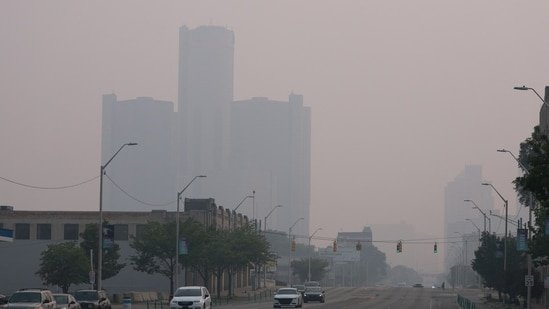
First alert has been issued Philadelphia Air quality in the area deteriorated due to arrival of smog Canadian Thursday’s wildfires and wildfires in northern Minnesota are expected to continue into Saturday.
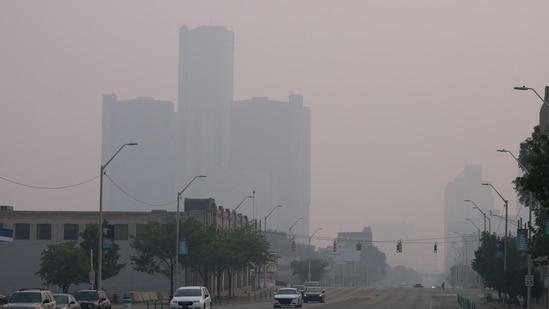
this pennsylvania The Department of Environmental Protection (DEP) issued a Purple Air Quality Alert for the entire state today. Earlier, Allegheny County was under a maroon alert. Depending on the location, a Code Maroon (most severe) or Code Orange (less severe) alert may be issued today.
The DEP recommends that all residents refrain from prolonged or strenuous outdoor activities during the Purple Alert.
Vulnerable groups, including children, the elderly and people with respiratory illnesses, should avoid outdoor activities entirely.
Additionally, people are encouraged not to use gas lawn equipment and light campfires.
Butler County Smoke
The smoke arrived in Butler County late yesterday morning, moved south into the city by early afternoon, and completely covered the area by the evening.
It’s expected to linger in the area today and could begin clearing out of southwestern Pennsylvania later tonight, according to the National Weather Service.
Three years ago, wildfire smoke from Canada turned the region’s skies into unsettling shades of orange and gray, obscuring landmarks and making Philadelphia’s skyline nearly invisible, and smoke is rising from more than 100 wildfires currently raging in Ontario.
Also read: Vanessa Trump’s health: Kay Trump gives update on mother’s condition after cancer surgery
Experts warn residents to watch out for health concerns
As smoke approaches the Philadelphia area, medical professionals are warning residents of possible health effects.
Dr. Leah Lande, a pulmonologist at Lankenau Medical Center, said wildfire smoke contains harmful gases, ozone and fine particulate matter that can cause significant health hazards, especially to children, the elderly and people with heart or lung disease.
Health authorities advise residents to minimize unnecessary outdoor activities, keep windows closed and stay in air-conditioned environments over the next few days.
To keep indoor air clean, the Philadelphia Department of Health recommends the following: Close all doors and windows, turn off or set air conditioners to recirculation mode, avoid activities that generate additional particulate matter indoors, such as smoking and vaping, using gas, propane or wood-burning stoves and heaters, spraying aerosol products, frying or grilling food, burning candles or incense, and vacuuming unless using a vacuum equipped with a HEPA filter.
If you don’t have air conditioning, staying indoors with your windows closed during hot weather can be risky. According to health department instructions, if you feel overheated, it is recommended to find an air-conditioned location.
When to seek medical advice
Dr. Rand recommends seeking medical attention if you experience: chest tightness, shortness of breath, cough, wheezing, and a fast or irregular heartbeat