
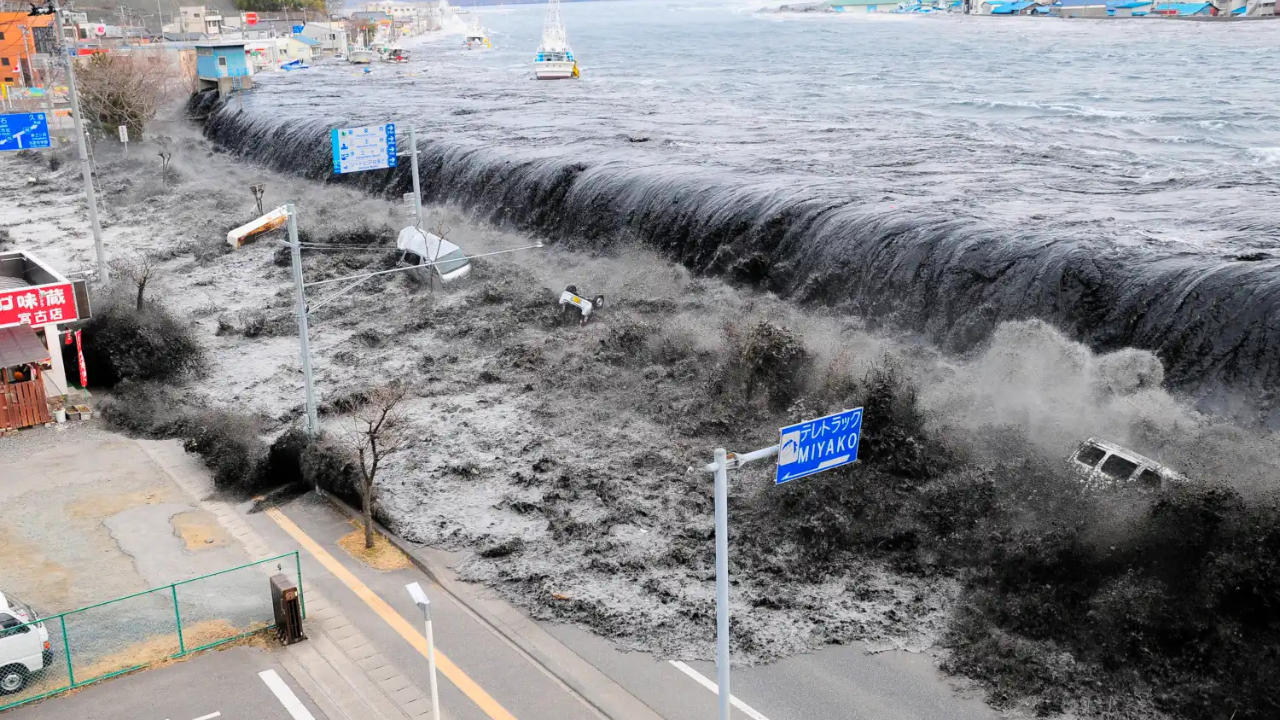
Seismic waves from Japan’s devastating 9.0-magnitude Tohoku-Oki earthquake in 2011 traveled nearly 2,900 kilometers to the Earth’s core boundary, reflected back about 13 minutes later, and moved the entire country eastward by about 6 millimeters, according to a study published in the journal Science. The movement was too small for anyone to notice, but Japan is highly sensitive GPS The network detected the nationwide shift at almost the same time. For 15 years, scientists were unable to explain the unusual signal because it did not match a mainshock, aftershocks or other known geological events. The new study identifies returning seismic waves as the cause, marking the first recorded observation of the phenomenon.
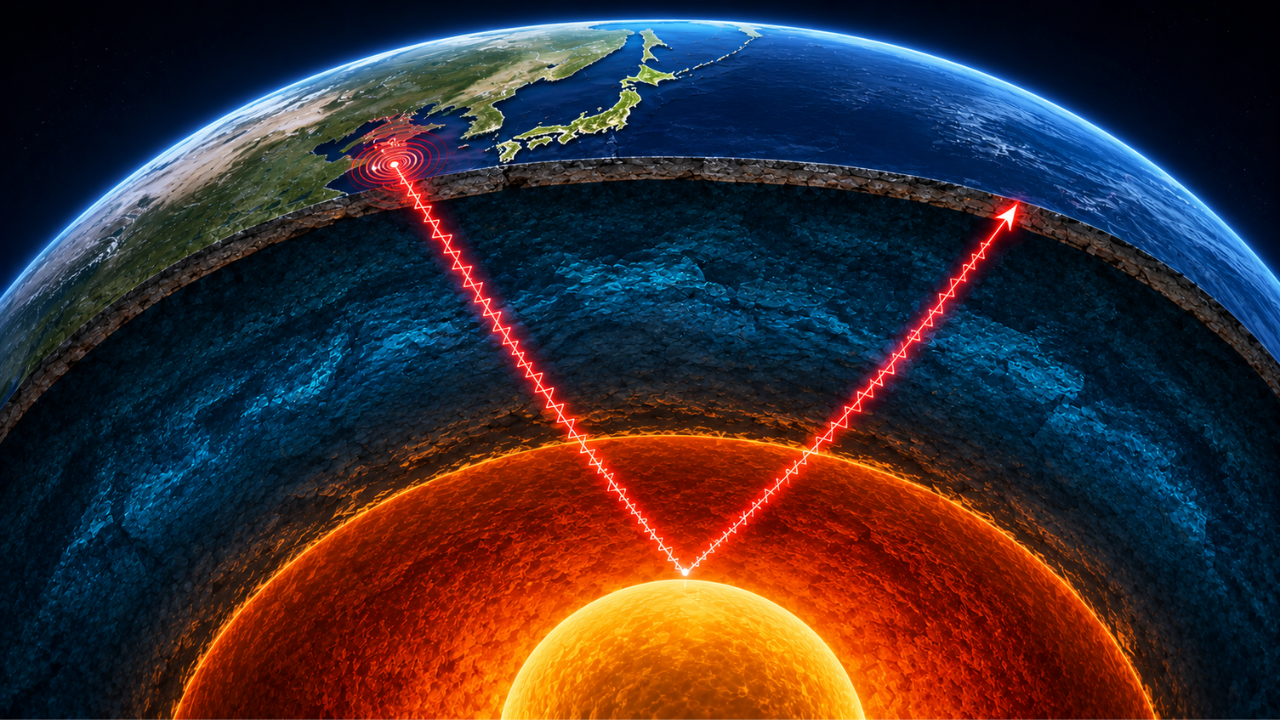
How waves travel nearly 2,900 kilometers below the Earth’s surface
The research was led by Sunyoung Park, assistant professor of geophysical sciences at the University of Chicago, Hiroo Kanamori of the California Institute of Technology, and Luis Rivera of the University of Strasbourg.The researchers found that the unexplained GPS signals were caused by ScS waves, a type of seismic shear wave produced during strong earthquakes. Unlike surface waves, which cause most of the vibrations people experience, ScS waves travel deep through the Earth’s solid mantle. After the 2011 Tohoku-Oki earthquake, one such wave descended nearly 2,890 kilometers until it reached the core-mantle boundary that separates the Earth’s rocky mantle from its liquid outer core.Shear waves cannot travel through liquid, so when the ScS wave reaches the molten iron and nickel in the outer core, it cannot continue its journey. Instead, it reflects off the core-mantle boundary and returns to the surface, like an echo bouncing off a wall. The complete round trip is nearly 5,800 kilometers, making it one of the deepest seismic journeys ever associated with measurable impacts on the Earth’s surface.The unusual magnitude of the Tohoku-Oki earthquake produced unusually strong ScS waves, allowing enough energy to survive long journeys through the Earth’s interior, the researchers said. As it returned to Japan, the wave was still strong enough to impact faults that had been pushed close to their breaking point by the main earthquake.
Why did the waves come back after 13 minutes?
Scientists calculated that the journey to and from the core-mantle boundary would take approximately 13 minutes, consistent with unexplained GPS signals recorded across Japan.When the reflected wave arrives, it reaches most of the country at about the same time. Researchers believe it triggered tiny slips along plate boundaries that were already experiencing the intense stress of the main earthquake. These small movements moved Japan permanently eastward by about five to six millimeters.Although the displacements are nearly impossible to measure, it is estimated that combined fault slip releases energy equivalent to a magnitude 7.5 earthquake.
Why has this never been observed before?
Seismologists have studied ScS waves for decades and often use them to study the depths of the Earth. What has never been observed is that a return is energetic enough to leave a permanent imprint on the Earth’s surface.Researchers say the Tohoku-Oki earthquake was unusual because of its magnitude. Reflected ScS waves have been recorded across Japan with peak-to-peak amplitudes exceeding one centimeter, much stronger than those produced by most earthquakes. Combined with an already stressed fault, this unusual energy appears to be enough to trigger additional ground motion.
GPS signals that have puzzled scientists for 15 years
Japan has one of the densest GPS monitoring networks in the world, with more than 1,300 continuously operating monitoring stations capable of detecting even the smallest ground movements.About 15 minutes after the earthquake, instruments recorded almost simultaneous eastward movement across the country. The pattern was inconsistent with a major rupture, any known aftershocks or submarine landslides, leaving scientists without a convincing explanation for more than a decade.New analysis finally links this long-standing anomaly to the returning ScS waves.
How researchers rule out other possibilities
The team evaluated several competing explanations before coming to a conclusion.If the main rupture continues to release energy, the motion should be strongest near the epicenter, rather than appearing almost uniformly across Japan. Likewise, unrecorded aftershocks and underwater landslides cannot explain the temporal and nationwide patterns observed by GPS networks.The researchers say reflected ScS waves are the only mechanism that explains all observations.
Implications of this discovery for earthquake science
The findings suggest that the effects of Earth’s largest earthquakes may be deeper and farther out than previously understood.So far, earthquake hazards have largely been associated with main ruptures, aftershocks, and tsunamis. Seismic waves that travel thousands of kilometers through the Earth’s interior may also trigger additional fault motion after reflecting from boundaries above the outer core, the study suggests.The researchers now plan to re-examine data from other major earthquakes, including the 2004 Sumatra-Andaman earthquake, the 1960 Valdivia earthquake in Chile, the 1964 Alaska earthquake and the 2010 Maule earthquake, to determine whether the same mechanism occurs elsewhere.
Discovery reveals Earth’s hidden inner structure
The study also highlights how scientists are studying parts of the planet that remain inaccessible. The deepest hole ever drilled, the Kola Superdeep Borehole in Russia, is only about 12 kilometers deep, while the mantle extends to about 2,890 kilometers before meeting the liquid outer core.Because humans cannot directly explore these depths, researchers rely on seismic waves generated by powerful earthquakes to understand the Earth’s internal structure. By showing that seismic waves propagate to the edge of the Earth’s core, return to the surface and have measurable effects, the Tohoku-Oki earthquake provides an unprecedented glimpse into the dynamic connections between the Earth’s deep interior and its crust.