‘From arsh to farsh’: Mani Shankar Aiyar’s ‘Rahulian’ outbreak and ‘uncle’ syndrome | India News

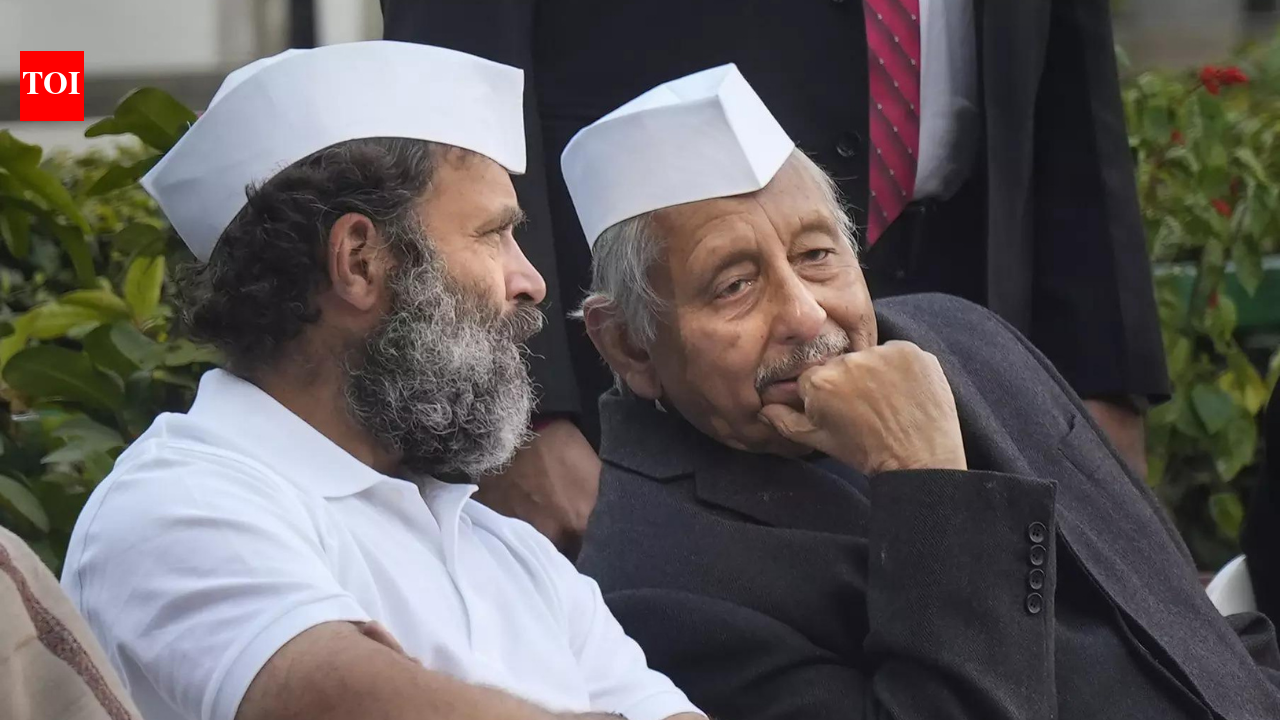
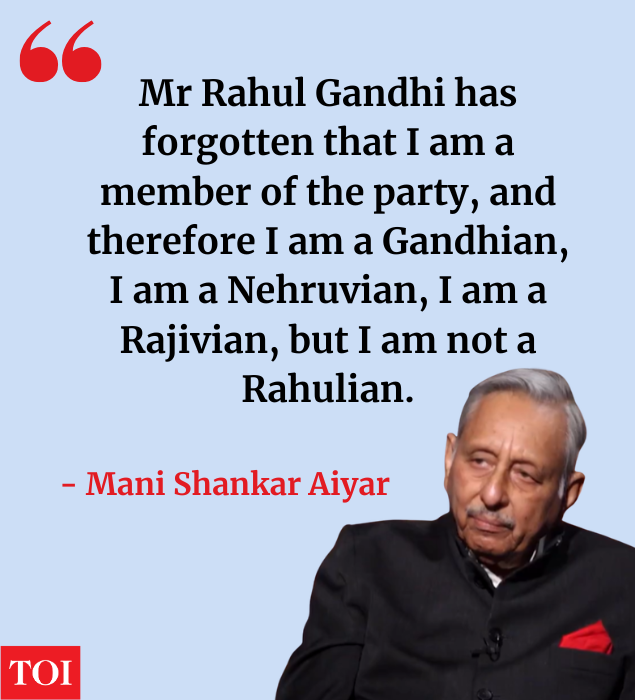
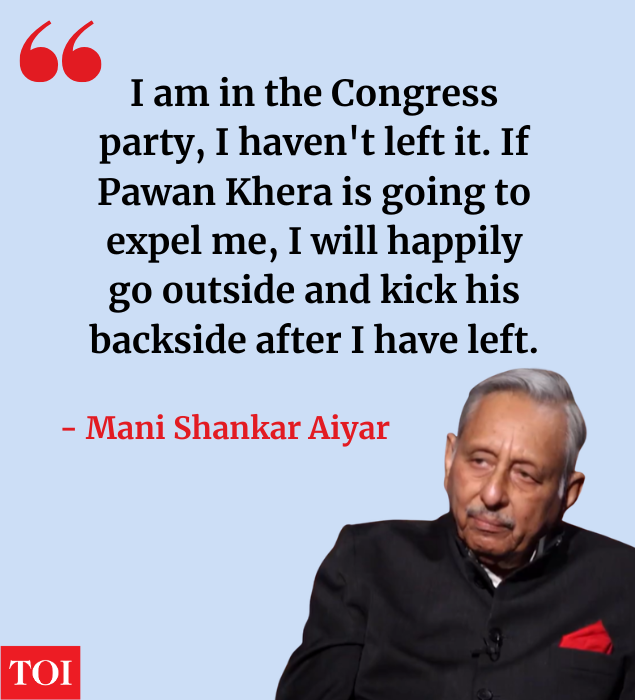
New Delhi: Being a senior leader Mani Shankar Aiyar Declaring that he is a “Gandhian, Nehruvian, Rajite, but not a Rahulite” may, at first glance, sound like another round of his familiar provocations. But this statement is based on congressAn attempt to show discipline and unity ahead of crucial parliamentary elections soon triggered a larger debate within the great old party over ideology, authority and dissent.The Congress party was quick to distance itself from Aiyar’s remarks and said the leader had no connection with the party. But is Aiyar just indulging in rhetorical rebellion, or is he pointing out the real story of how Congress has changed “underneath”? Rahul Gandhi?Rasheed Kidwai, a political analyst and chronicler of Congress, believes there is “some truth” in Aiyar’s claims, but not in the way the former minister imagined.
Also read: Mani Shankar Aiyar returns, Congress ducks for cover again
From Nehruvianism to ‘civil society’ politics
“There is some truth to what Mani Shankar Aiyar said because the Congress has moved away from a Nehruvian way of looking at things to a Nehruvian ideology of civil society,” Kidwai explained.
Rahul Gandhi has not started over yet. He has three or four uncles who take care of him.
Rasheed Kidwai, author and political analyst
According to him, this transformation did not happen overnight. He believes that Congress has gone through three different ideological stages.“The previous Nehruvian thinking…the Congress moved away from Nehruvian thinking towards economic reforms, from the economic reforms of the days of Narseemhar Rao and Manmohan Singh Rao to more civil society thinking,” he said.
Kidwai believes this shift helps explain why Aiyar’s attacks on “Rahul” politics have resonated in some quarters. The Congress “under Rahul Gandhi” did not operate within a strict ideological framework in the classical sense.“So what you see around Rahul Gandhi are people from civil society who are influencing him. So civil society does not have a dogmatic ideology,” Kidwai said.This lack of dogma, he argued, would have consequences for the party’s political response. Unlike the Nehruvian era, when ideology influenced policy, or the reform years, when economic pragmatism dominated, today’s Congress often appears passive and issue-oriented rather than programmatic.
The impact of “Jai Jagat”
Kidwai had earlier written about what he described as a growing “civil society” imprint within the Congress, particularly around Rahul Gandhi. This school of thought, he argued, prioritizes moral argumentation, decentralized activism, and individual agency over state-led or party-led political action.Kidwai writes that this direction gained traction through bodies such as the National Advisory Council during the UPA period under Sonia Gandhi and has now “almost taken over the party organization under Rahul Gandhi”.
Mani Shankar Iyer was completely isolated. No group, no leader inside or outside Tamil Nadu would agree with Mr. Mani Shankar Iyer’s views.
Rasheed Kidwai, author and political analyst
Civil society protagonists, often associated with the so-called “Jai Jagat” group, are said to be close to Rahul Gandhi and hold influential roles in the organization. Their emphasis on austere living, minimalism, and symbolic politics has become part of Congress’s contemporary aesthetic.However, as Kidwai noted in his earlier work, this culture was at odds with traditional Congress leaders who had risen through the ranks and understood politics as negotiation, organization, and power management rather than moral signaling.
Aiyar isolated within Congress
Aiyar has positioned himself as the guardian of the Congress party’s ideology, while Kidwai has been outspoken about his position within the party.“Mani Shankar Aiyar believed that he represented the ideology of the Congress party, whether it was Panchayati, foreign policy or pro-poor socialism… That won’t work. So Mr Aiyar had no takers,” Kidwai said.“Mr Aiyar is completely isolated. No group, no leader in or outside Tamil Nadu will support Mr Mani Shankar Aiyar,” he added.Kidwai contrasted Aiyar’s isolation with that of other Congress leaders who disagreed with Rahul Gandhi but retained organizational influence.“Shashi Tharoor and many others still have some influence in the Congress… Manish Tiwari et al. But no one will support Mani Shankar Aiyar,” he said.Kidwai believes that Aiyar’s paradox lies in his political identity. “Mani Shankar Aiyar became famous because of his loyalty to Rajiv Gandhi,” he said. “Now he is facing Rajiv Gandhi’s son, which is a bit of a contradiction,” Kidwai added.This contradiction is at the heart of Aiyar’s frustration.
Dissent, Discipline and “Uncle Syndrome”
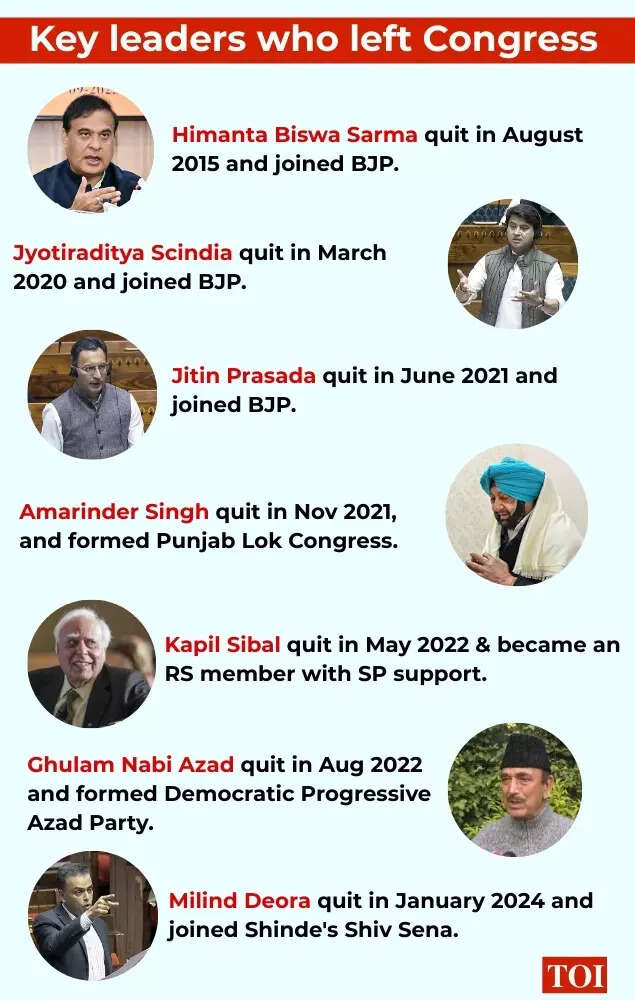
Aiyar once again claimed that past Congress tolerated rebels while today’s leadership punished them. But is this true?“In most parties, when adversity strikes, they split,” he said, recalling the Congress split in 1967, 1969, post-1977 and party splits during and after Narasimha Rao’s time.Kidwai believes that what makes the post-2014 period unusual is not its intolerance but its tolerance.“What happened from 2014 to 2024 and now 2026 is very unique in that there was a long period of adversity but no division. 150 leaders left but the Congress was not divided,” he said.
The result is a party burdened with the baggage of multiple generations of leaders.“Rahul Gandhi did not get a clean slate. He had three or four uncles looking after him,” Kidwai said. “Mani Shankar Aiyar was an uncle and he said – you are not doing the right thing.”Also read: The crisis of the old party – why Congress members parted waysEyal’s anger is deeply personal. “He felt that during the Rajiv Gandhi era, he was in the ‘arsh’, which means cloud line. And he is now in the farsh (ground),” he said.He added that Aiyar was not resigned to having less contact with the Gandhi family. “He was very hurt and angry about the whole thing,” Kidwai said.
Why Congress finally drew the line
Aiyar has made the Congress blush many times with remarks like “chaiwala” and “neech aadmi”. There is nothing new about the recent outbreak. So is Congress now taking action after all these years to make it clear that he has no affiliation with the party? Kidwai attributes this to changes in internal equations.“Mr Sam Pitroda and Mr Mani Shankar Aiyar are believed to be close to the family,” he said. This closeness once acted as an insulator.But Kidwai believes the cover has disappeared. “It is now known that he did not have the support of his family. So Mr Aiyar had a false cover … which has now been exposed,” he said.Kidwai noted that Pitroda, by contrast, remains protected. He said: “Mr Sam Pitroda remains in Rahul Gandhi’s good books, so no one talks about him.” Although, in Kidwai’s words, both men were “big mouths” whose remarks often “damaged the political interests of the Congress”.
Spin doctor without party
Kidwai traces Aiyar’s provocative instincts to his past.“Mr. Mani Shankar Aiyar was an original political opinion expert before the boom of social media and the internet,” he said, recalling Aiyar’s diplomatic career and his role as a key aide to Rajiv Gandhi.Kidwai believes that this instinct is still intact, but now operates independently of institutions.“He tried to get the attention of Sonia Gandhi, Rahul and Priyanka… but he didn’t get it,” Kidwai said.Kidwai believes that Aiyar’s use of the term “Rahulian” is part of this attention-seeking strategy rather than a serious ideological intervention.“He has the ability to spin and that’s what he’s doing,” Kidwai said.But is Aiyar’s warning justified?Although dismissive of Aiyar’s influence, Kidwai does not entirely deny his diagnosis.“There is an uncomfortable feeling, but it’s not palpable,” he said, referring to unease within the Congress over Rahul Gandhi’s reliance on civil society opinion rather than organizational consensus.He pointed out that campaign slogans and campaigns like “chowkidar chor hai” and “vote chori” were not examples of strategies that emerged from the party’s deliberations.“None of this stuff is coming from the Congressional organization,” Kidwai said.However, unlike Shashi Tharoor who secured 11 to 12 per cent votes in the 2023 Congress presidential elections, Aiyar does not have any followers.“Mani Shankar Aiyar will get zero points,” Kidwai said bluntly.Now, Aiyar has coined the new term “Rahuryan”, which Congress opponents may try to keep in mind. However, its founders may become further irrelevant.Aiyar may have been referring to something real, namely an ideological shift from structural doctrine to civil society politics. But Kidwai believes that in doing so, he is personalizing a shift that is bigger than Rahul Gandhi and older than Aiyar’s own grievances.Ultimately, Aiyar’s rebellion may say more about a veteran’s inability to accept that the party he once shaped can move forward without him than about the future of the Congress party.