
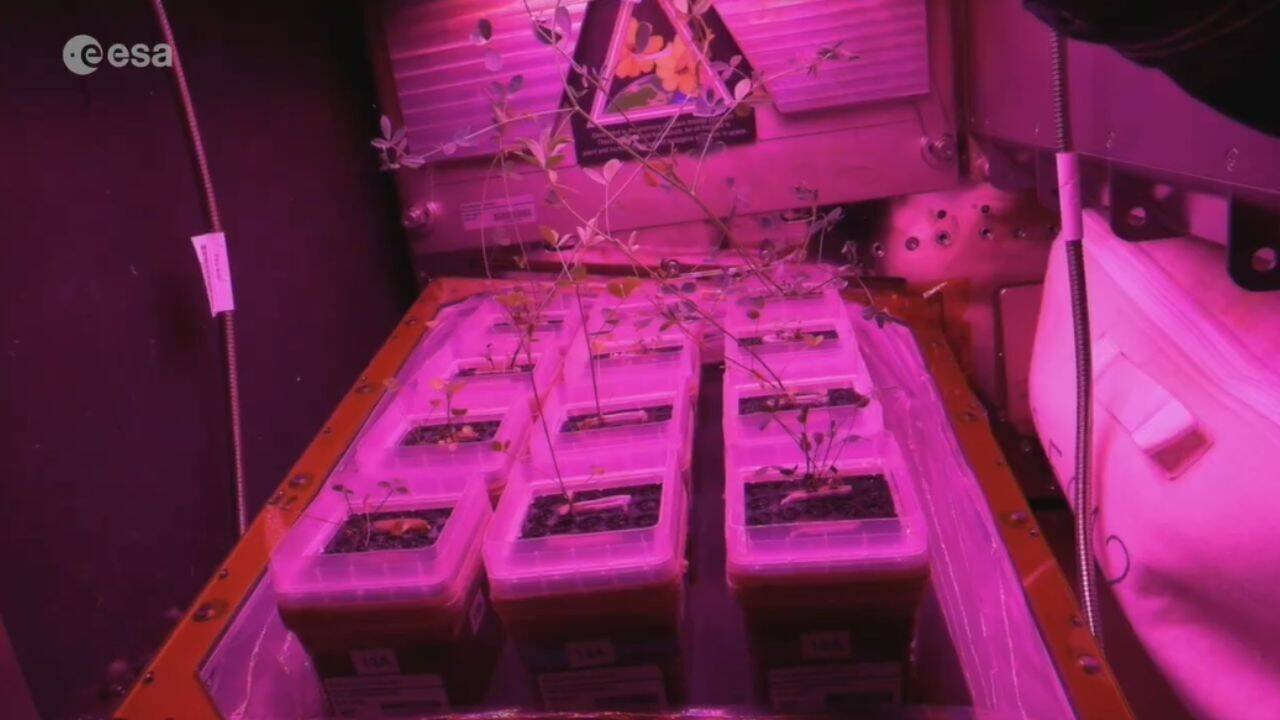
The pink light seen in a recent time-lapse video taken from the International Space Station is not a camera effect or a reflection from Earth. Instead, it comes from a small plant-growing facility inside the space station’s Columbus Laboratory, where astronauts have been tending crops as part of ongoing experiments on how plants behave beyond our planet.ESA astronaut Sophie Adenot detailed the project in a recent post shared on X, describing the bright room, called Veggie, as the station’s “little space garden.” She explained that the unusual magenta glow comes from lighting specifically designed to support plant growth on the track. According to the European Space Agency (ESA), the facility was used during Expedition 74 to host research into how plants develop in microgravity and how they interact with beneficial microorganisms.
International Space Station scientists study space plant growth
Most people wouldn’t associate the space station with gardening. Yet for years, scientists have been trying to grow vegetables and other crops in orbit, hoping to learn how future astronauts would produce food on long-duration missions.The latest investigation focuses on alfalfa, a flowering plant grown widely across the planet for animal feed and soil improvement. According to the European Space Agency, the experiment aims to understand how alfalfa works with naturally occurring bacteria to convert atmospheric nitrogen into compounds that plants can use.This process is routine in Earth’s ecosystems, but conditions on the space station are very different. The researchers were interested in whether these biological partnerships continued to function in the same way in the absence of gravity affecting root growth, water movement and plant development.
Space-grown plants may develop differently in microgravity; scientists find
The project, called Veg-06, is not limited to nitrogen-fixing bacteria. The researchers also wanted to examine changes in lignin, a structural material found in plant tissues.Lignin acts as a natural support system, helping the stems stay upright and giving the plant rigidity. On Earth, gravity has always played a role in shaping the development of these structures. In orbit, this force is largely absent, giving scientists the opportunity to study whether plants structure themselves differently.The answers could help researchers better understand plant biology under unusual conditions, while also providing insights relevant to planetary agriculture.
Researchers examine structural and chemical changes in space plants
The alfalfa crop completes its growth cycle on the space station. According to ESA, the astronauts harvested the above-ground parts of the plants and their roots before placing the samples in cold storage.The samples were later returned to Earth on SpaceX’s CRS SpX-34 cargo mission, where researchers will perform detailed analyzes not possible in orbit.Now, the work moves from the space station’s growth chambers to ground-based laboratories, where scientists can compare plants grown in space to those on Earth and look for subtle differences in structure, chemistry and microbial activity.
Space gardening offers scientific and psychological benefits to astronauts
While this study is aimed at future exploration, astronauts often talk about plants in a more personal way. In her X post, Adeno described the experience of tending the crops as a reminder of home, saying there was something special about watching the plants grow and tending to them every day.This sentiment reflects a broader theme that has emerged from years of space plant research. Green leaves, earthy smells and the routine of caring for living things can provide a familiar connection to Earth in the highly engineered environment of a spacecraft.According to ESA, the ability to grow fresh food could eventually become an important part of expanded missions beyond low Earth orbit. In addition to nutritional benefits, researchers are also interested in how plant cultivation could support crew health during journeys that could last months or even years. For now, the glowing pink room remains a small corner of the International Space Station.