
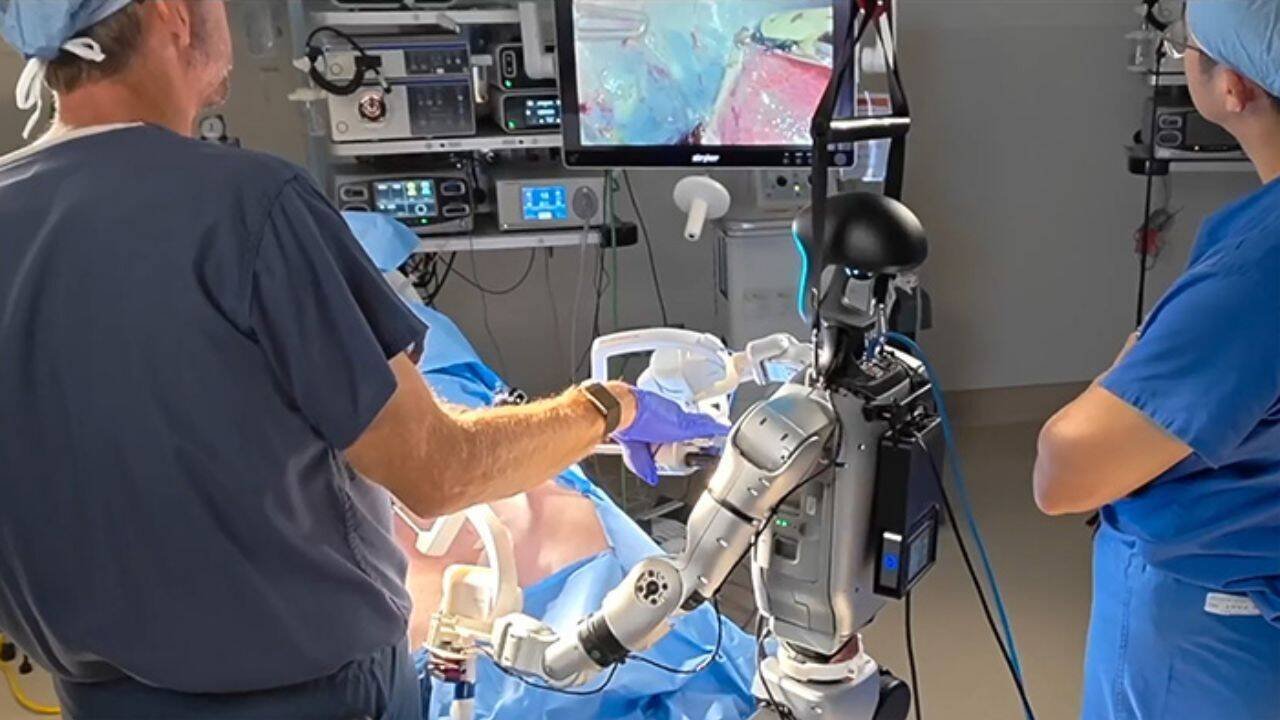
Robotic surgery has become a familiar part of modern healthcare, but the machines used in operating rooms are often specialized systems designed for limited tasks. Humanoid robots, despite their rapid development in recent years, remain largely outside the surgical setting. That has begun to change. A team of engineers and surgeons at UC San Diego has demonstrated that a remote-controlled humanoid robot can successfully perform minimally invasive surgery in real time in preclinical trials. According to a study titled ” “In vivo feasibility study of humanoid robots in surgery,” it marks the first time a humanoid robot has performed such a procedure on a living subject and provides a first look at what the operating room of the future might look like if these systems continue to mature.
Learn about surgery : Humanoid robot built for hospital operating rooms
Today, most robotic surgical platforms in hospitals are large, specialized machines designed for procedures such as laparoscopic surgery. They provide surgeons with highly precise control, but are expensive, take up a lot of space, and require dedicated infrastructure.According to UC San Diegothe project took a different route. Rather than employing traditional surgical robots, the team developed a teleoperation framework around a universal humanoid robot. The robots, which are about 5 feet tall and weigh about 60 pounds, are designed to use standard laparoscopic instruments rather than custom surgical hardware.The researchers nicknamed the system “Surgie.” During the test, surgeons remotely controlled the robot through a remote operating interface, allowing the machine to imitate human movements and perform delicate surgical procedures.The authors describe this work as evaluating whether current humanoid technology can meet the precision, control, and safety requirements associated with minimally invasive surgery.
Humanoid robot completes living gallbladder removal surgery
Preclinical trials involved two separate cholecystectomy surgeries in large non-primate mammals. During one surgery, a humanoid robot worked alongside a human surgeon, forming a human-robot surgical team. During the second surgery, two remote-controlled humanoid robots worked together, each handling laparoscopic instruments while performing the surgery.Both procedures were completed successfully. This achievement is significant because it takes humanoid robots beyond laboratory demonstrations and simulated surgical exercises. According to the study, the project includes extensive testing ranging from controlled bench experiments and dry laboratory evaluations to field surgical procedures, allowing researchers to evaluate technology performance under increasingly realistic conditions.Rather than focusing solely on whether the robot can complete individual tasks, the team sought to measure how close current humanoid systems come to the standards expected in a real surgical setting.
How humanoid robots are expanding surgical opportunities around the world
The motivation behind the project extends beyond robotics research. Healthcare systems in many countries face shortages of trained surgical personnel, while demand for treatment continues to grow. This imbalance can lead to delays, reduced access to specialty care, and widening gaps between urban health centers and remote communities.Remotely operated and eventually autonomous humanoid systems could help expand access to surgical care in areas where recruiting specialists is difficult, said Michael Ye, a professor in the Department of Electrical and Computer Engineering at UC San Diego and one of the study’s senior authors.“Teleoperated and autonomous humanoid robots really have the potential to expand patients’ access to critical surgeries that would otherwise be unavailable to them,” Ye said. “This could help solve a medical crisis not only in the United States but around the world.”Unlike large robotic surgery platforms, which often require specially configured operating rooms, humanoid robots can move in spaces designed for humans. The researchers believe this flexibility could make them easier to deploy in small hospitals, temporary medical facilities and emergency response settings.
Humanoid robot integrates seamlessly into existing operating rooms
An unexpected result of the trial was how naturally the humanoid robot fit into a standard surgical workspace.While adapters had to be developed to enable the robots to accommodate traditional instruments, these machines are able to operate in existing operating room environments without the extensive modifications typically associated with dedicated robotic systems.Nikita Thareja, a general surgery resident at UC San Diego School of Medicine and co-author of the study, said the team was surprised by how effectively the robot adapted to existing workflows.The researchers believe this compatibility could become one of the technology’s strongest advantages. Rather than redesigning hospitals around robotic platforms, hospitals can introduce humanoid assistants into existing environments.
Can humanoid robots achieve the accuracy of surgical robots?
A core question surrounding humanoid surgery is whether universal robots can achieve the level of precision required for delicate surgeries.Shanglei Liu, an assistant professor of surgery at the University of California, San Diego and one of the senior authors, said the surgical accuracy of the remote operating system is comparable to existing robotic surgery platforms.However, this technology is still far from daily use. The surgery takes much longer than those performed using mature robotic systems because the robot needs to be recalibrated multiple times during operation. There are also technical challenges involving latency, the delay between the surgeon’s actions and the robot’s response, especially when considering future remote operations over long distances.According to the study, these limitations are important areas for improvement. While current humanoid platforms have demonstrated feasibility, the authors emphasize that further advances in control systems, reliability, and safety are needed before any clinical deployment becomes realistic.
Humanoid robots could play a variety of roles in hospitals
The UC San Diego team doesn’t necessarily envision humanoid robots serving solely as robotic surgeons.Because these machines are mobile and can interact with human-designed environments, researchers are finding they have a wider range of responsibilities within hospitals. Humanoid assistants can transport equipment, retrieve instruments, prepare work spaces or help manage operating room logistics before and after surgery. Ye said a long-term goal is to develop an autonomous surgical assistant capable of supporting medical teams who are unable to access treatment due to staff shortages.Our vision is not for robots to replace medical professionals, but rather for an integrated team in which human clinicians and robotic systems share responsibilities based on their respective strengths.