
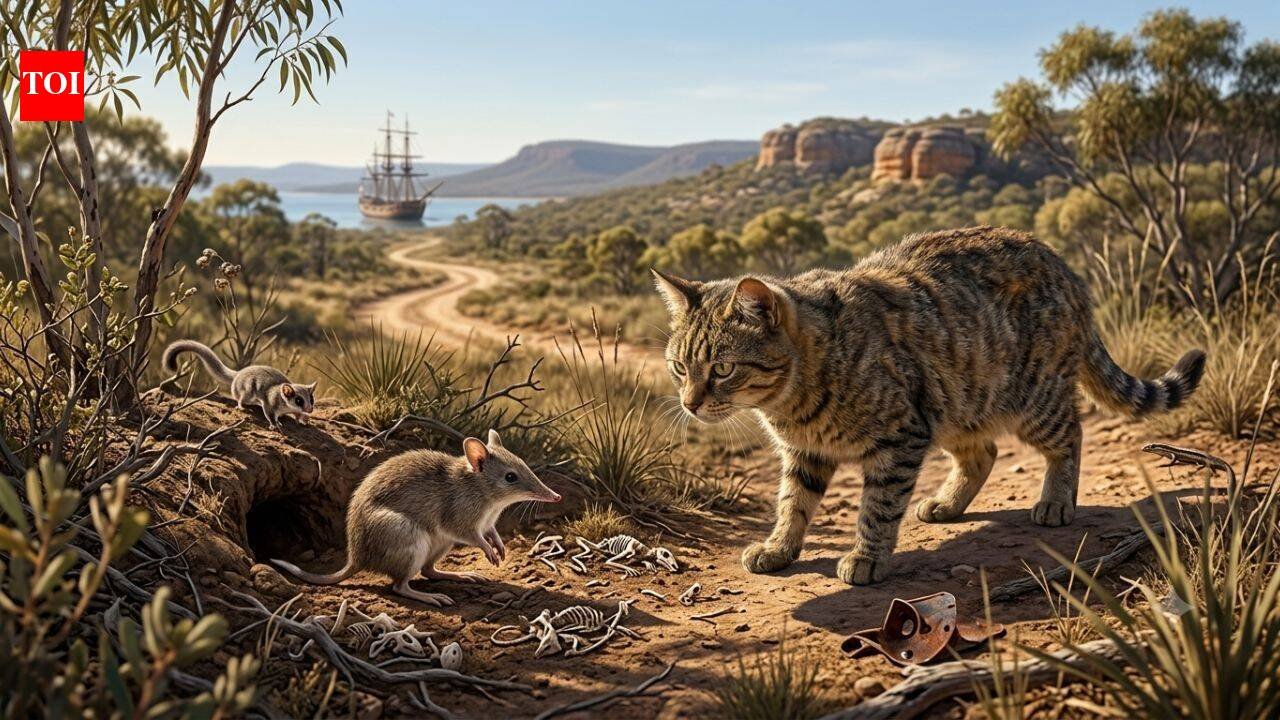
Domestic cats arrived in Australia with the First Fleet in 1788 and were introduced as familiar companions and a practical method of controlling rodents. Within decades, many fled or were abandoned, gradually establishing wild populations far from early settlements. By the end of the nineteenth century, they were spread across nearly the entire continent, adapting to landscapes ranging from humid forests and mountains to some of the driest deserts on Earth. More than two centuries after their arrival, feral cats have become one of the country’s most persistent environmental challenges. Their success lies not just in numbers, but in their ability to survive almost anywhere while hunting large numbers of native wildlife that have evolved in the absence of such efficient predators.
How feral cats populate nearly every corner of Australia
Australia is currently home to an estimated 1.4 to 5.6 million feral cats, although numbers fluctuate with rainfall, food availability and seasonal conditions, reports the Western Australian Feral Cat Working Group. Unlike domestic pets, these animals survive entirely by hunting, often traveling long distances through jungles, grasslands and remote outback areas.Their diet varies depending on the food available, which partly explains why they have been able to spread so successfully. Small mammals, reptiles, frogs, birds and large invertebrates all become prey. They are capable of preying on small skinks weighing just a few grams, but they have also been recorded killing wallabies approaching their own weight.Even isolated habitats offer little protection. Feral cats now occupy nearly the entire Australian continent and more than a hundred offshore islands, reaching the last stand of many threatened native animals.
How millions of hunting cats are changing Australia’s ecosystem
Cat predation has become one of the greatest ongoing pressures facing Australia’s native animals. According to reports, feral cats alone are estimated to kill approximately 272 million birds, 466 million reptiles, 815 million mammals, and approximately 1.1 billion invertebrates each year.If you include pet and stray cats, the total number of native animals exceeds three billion each year. The Department of Climate Change, Energy, Environment and Water reports that a wild cat living in the bush could kill nearly 1.5 billion native mammals, birds, reptiles and frogs and 1.1 billion invertebrates each yearThese losses were accumulated over decades rather than occurring as a single event. Small mammals that once occupied vast areas have gradually disappeared from many areas, while isolated populations continue to shrink under continued predation pressure.
Growing threats to Australia’s native fauna
Australia has one of the highest mammal extinction rates in the world since European colonization, and feral cats are thought to be a significant factor in many extinctions.They are responsible for the loss of 27 of Australia’s 34 extinct native mammal species, in addition to two native birds and all three reptiles recorded since colonization, pestSMART and the Invasive Species Council report. Their impacts extend beyond the species that have disappeared. Dozens of threatened mammals, birds, reptiles and amphibians still face cat predation across the country.Some species are considered particularly vulnerable because their populations have become fragmented or restricted to small areas. Conservation assessments indicate that animals such as the central rock rat, Gilbert’s kangaroo, western ground parrot, nabarek and black-footed tree rat will be increasingly at risk of extinction without continued cat management in the coming decades.
Wild animals that never evolved with cats
Many Australian mammals evolved in an environment where few predators could stalk at night as quietly as cats. Species such as bandicoots, kangaroos and other small marsupials often show limited behavioral responses to this type of hunting, leaving them unusually exposed.The problem isn’t just direct attacks. Cats are the only host required for the life cycle of the parasite that causes toxoplasmosis, allowing the disease to be spread through native wildlife after infectious agents enter the environment.In susceptible marsupials, infection can cause blindness, poor coordination, difficulty breathing, miscarriage, and death. Birds and many other mammals can also become infected, adding another layer of pressure to already declining populations.
Feral cat removal is bringing back lost wildlife
Western Australia supports some remaining populations of wild species that have disappeared elsewhere. Animals such as anteaters, kangaroos, spotted hare-kangaroos and golden-backed tree rats survive there, making cat control an increasingly important part of conservation plans.The Biodiversity Science Institute of Western Australia reports that there are an estimated 720,000 feral cats in the state. Together they prey on hundreds of millions of native birds, reptiles and mammals each year, while domestic and stray cats consume hundreds of millions more.There are some examples where feral cat eradication has produced measurable results. On Dirk Hartog Island, native mammals including spotted rabbit wallabies and burlap rats were successfully reintroduced after feral cats were eradicated, providing evidence that threatened species can recover when predation pressure is removed.
Australia still struggling to contain feral cats
The management of feral cats remains one of Australia’s longest-running conservation issues because feral cats occupy such a large area and reproduce successfully under vastly different environmental conditions.Control programs have produced local improvements on an ongoing basis, particularly on islands and within fenced reserves. Outside these protected areas, reducing predation on millions of square kilometers remains much more difficult.More than two centuries after cats first arrived with European settlers, their presence continues to shape Australia’s wildlife, agriculture and ecosystems in ways that go far beyond their familiar image as household pets.