
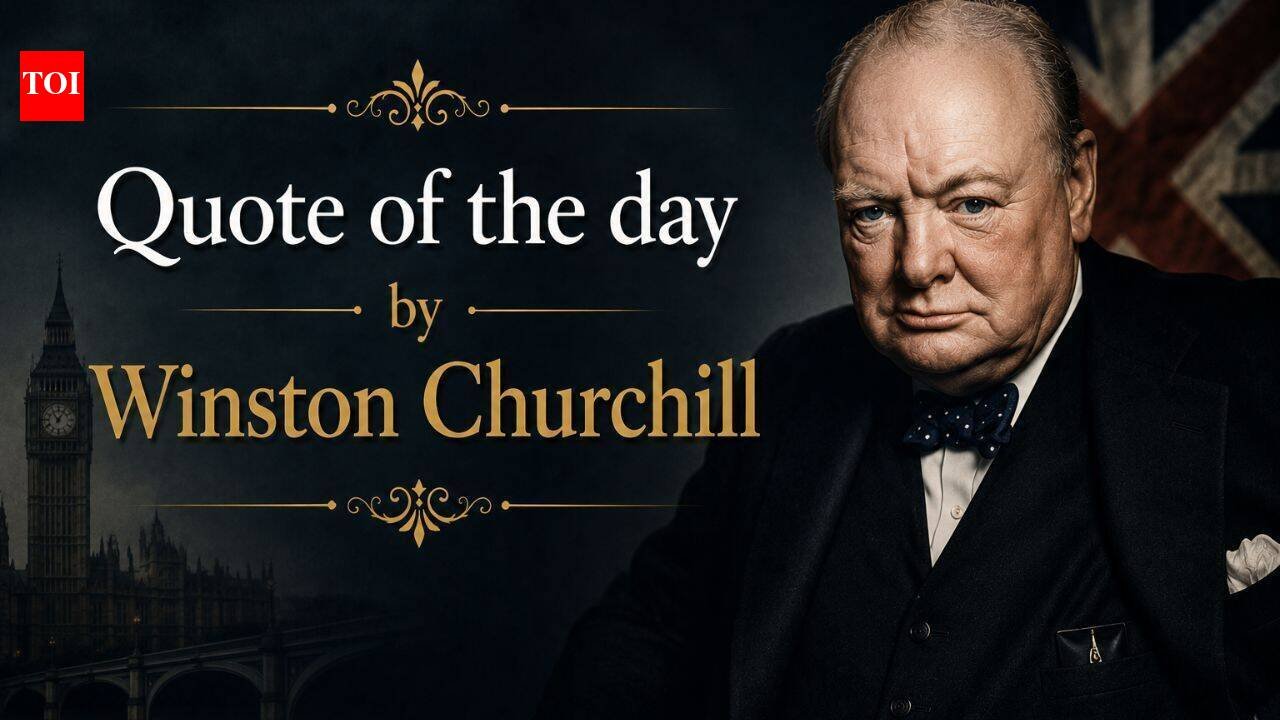
When asked if they are afraid of death, most people either avoid the question or answer seriously. Winston Churchill had neither. “I’m ready to meet my maker,” he said. “Whether my Creator is ready for the great trial of encountering me is another matter.“This is one of the most quoted lines of poetry on the topic of death, and hardly any of the usual gravity associated with the subject survives. Churchill turned the biggest and most inevitable fact of life into a joke, and at his own expense, without really denying the seriousness of the subject. This line outlived him by decades precisely because it managed two things, honesty and humor, simultaneously, in a sentence that most people would need an entire paragraph to attempt.
Who is Winston Churchill?
Churchill led Britain through World War II as prime minister and remains one of the most widely quoted political figures of the twentieth century, equally renowned for his wisdom and wartime leadership. He made these particular remarks at a press conference in Washington in late 1954, around his 80th birthday. By this time, he had endured two terms in Downing Street, several serious illnesses and a level of public scrutiny that few politicians had faced in decades.By that stage of his life, Churchill had earned a reputation for taking the opportunity to turn almost any subject, no matter how serious, into a memorable line. Journalists almost naturally expect his wit, and most public figures guard their answers to questions about aging or death, which just gives him his favorite opening.By 1954, his health had become a matter of public speculation. He suffered a severe stroke last year that was largely hidden from the public at the time, and he has battled recurring bouts of pneumonia and depression for decades, which he privately described as a “black dog.” None of this has stopped him from publicly treating his own death as a subject of comedy rather than one of concern, which is part of the reason why his words carry more weight than the glib words of a younger, healthier man.
Winston Churchill’s Quote of the Day
“I am ready to meet my Maker. Whether my Maker is ready for my great ordeal is another matter.”
Learn the meaning of Winston Churchill’s famous quotes
The joke works because it overturns an assumption that almost everyone automatically makes. When facing death, the natural question is whether you are ready for what comes next. Churchill answered the question immediately and confidently, then flipped the entire frame, suggesting that the more interesting uncertainty was not that he was ready, but that the universe itself was ready for him.Behind the jokes lies a genuine confidence. Most people who claim to be at peace with death do so softly, almost apologetically. Churchill said this as he did everything else, treating even his own death as fodder for a good line rather than as a subject that must always be dealt with seriously.
Churchill had a lifelong habit of laughing about serious things
This was not a one-off performance for the benefit of journalists. Churchill built an entire public persona around finding jokes in the most serious of situations, from wartime speeches that mixed scorn and dry humor to parliamentary exchanges where his most pointed lines were often the hardest to land because they were funny. At one point, in response to an insult from a political opponent, he said that when she sobered up, he would be happy to explain to her the differences between the two of them, and throughout much of his public life his remarks were the same, sharp, carefree, and engaging.This habit naturally extended to the way he talked about his decline. As he grew older, he did not shy away from questions about age and mortality, but leaned into them, using the same comedic instincts that had led him through decades of political struggle. The Maker quote is really just a particularly perfect example of a lifelong pattern, not an exception.Even his own funeral arrangements (planned in detail years before his death in 1965) reportedly contained instructions consistent with the same instinct that this was a national occasion grand enough to match his sense of his own historical importance and presented with the theatrical panache that he brought to almost everything else in his public life. Churchill did not treat death as a subject that could be dealt with quietly after his death. Until the end, he treated it as just another stage to perform.
Why humor about death doesn’t equate to denial
It’s easy to mistake this kind of joke for avoidance, which is to avoid an uncomfortable topic by making light of it. Churchill’s version did something different. The joke works because he’s made it clear he’s ready for it. Humor comes later, on a basis that most people would have a hard time honestly admitting.This is a useful distinction worth insisting on more generally. True humor about a difficult topic often requires first facing the topic honestly. Jokes used to escape harsh truths often feel hollow because the truth continues to be obscured. A joke used after a hard truth has been clearly stated, much like Churchill’s way, tends to lead to confidence rather than evasion.The order of the two halves of the sentence determines how it works. Turn them around, joking first and acknowledging later, and the sentence loses almost all its power and reads flippant rather than calm. In the order actually used by Churchill, death is first acknowledged, settled and calm, and only then is joking allowed. This ordering is no accident. That’s the difference between tact and avoidance in almost any difficult conversation, not just this one.
How to apply this quote from Winston Churchill to your daily life
You don’t need to face your own mortality to borrow something useful from this quote. Most people have at least one topic that they feel is too heavy to discuss honestly, like health worries, career failure, fears about the future, and default to either avoiding it entirely or discussing it too seriously, making everyone around them uncomfortable.Churchill’s approach suggested a third option. Let’s get the hard stuff out first. Only then, once it’s actually acknowledged rather than avoided, can there be a more relaxed tone without it feeling like an avoidance. Trying to make a joke before admitting it honestly usually backfires. Playing for it after the fact, as Churchill did here, tends to put people at ease rather than unsettle them further.
Other quotes by Winston Churchill
- “Success is not final, failure is not fatal: what matters is the courage to keep going.”
- “We make a living by what we get, but we make a life by what we give.”
- “If you’re going through hell, just keep going.”
- “A pessimist sees difficulty in every opportunity. An optimist sees opportunity in every difficulty.”