
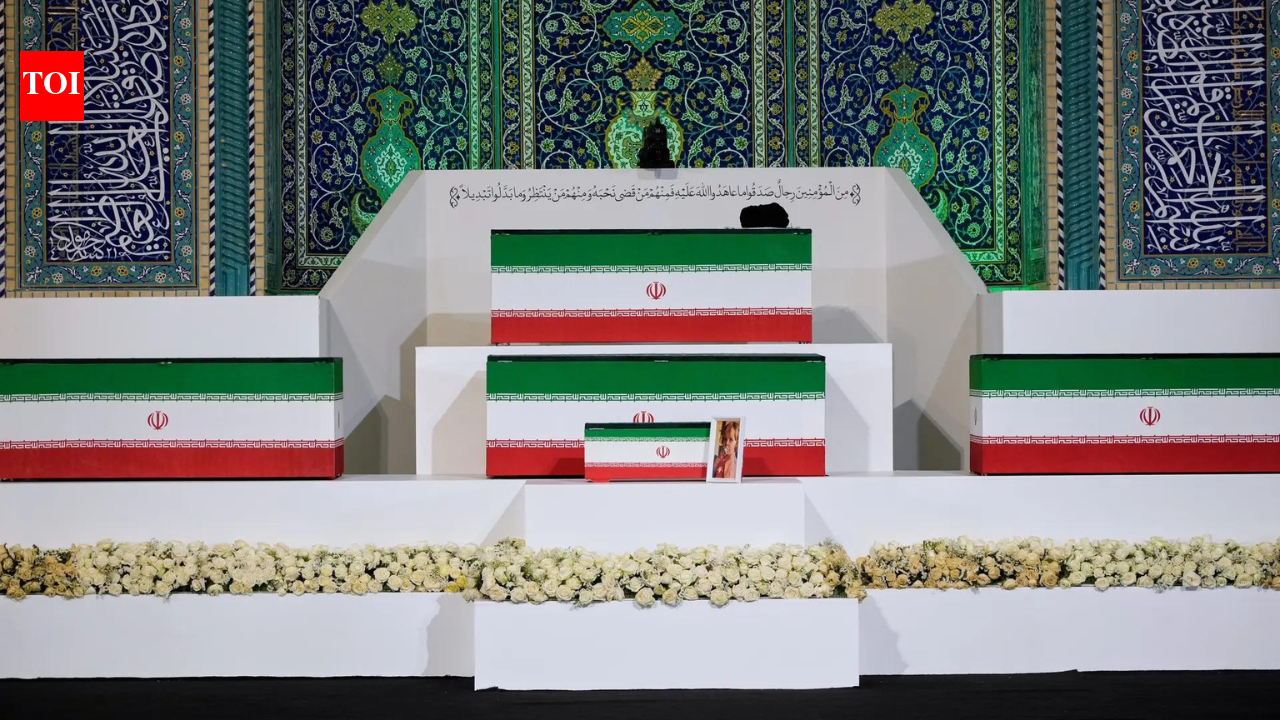
TEHRAN: Tens of thousands of Iranians gathered at a large outdoor prayer center in Tehran on Saturday to pay respects to the coffins of supreme leader Ayatollah Ali Khamenei and his family who were killed at the start of the US-Israeli war against Iran.Mourners, dressed in black and draped in the red, white and green flags of the Islamic Republic of Iran, held aloft portraits of Khamenei and his son and successor Mojtaba.In a show of public loyalty and revolutionary fervor to the Islamic republic’s theocratic state, Iran is holding a week of massive funeral processions for its supreme leader who was killed in an airstrike at the start of the war in February.Khamenei’s coffin remained indoors for a day for visits by senior Iranian leaders and foreign officials before being placed on display outdoors under glass along with the coffins of his daughter, son-in-law, daughter-in-law and 14-month-old granddaughter. There have been no public sightings of the new leader, Mojitaba, nor a photo of him, said to have been injured in the attack that killed his father.Mourners filed into the vast courtyard of the Imam Khomeini Grand Mossara, beating their chests, weeping and waving the flags of the Islamic Republic. Women in black burqas wore white sun hats or held umbrellas to protect themselves from the hot midday sun.“Let’s cry!” the host encouraged the crowd through a loudspeaker. Chants of “Death to America” echoed in the vast prayer hall.“Everyone here came to avenge their supreme leader,” 40-year-old Arash Rahimi told Reuters from the crowd. “As our leaders have said, we have a blood feud with the United States. Our relationship with the United States will never be good.”The funeral comes at a critical time for Iran, whose clerical rulers, backed by the military, are heartened by having survived the attack with their ruling system intact.In Iran’s theocratic system, Khamenei is not only the head of state and leader of the revolutionary movement, but also the secular representative of the last imam of Shia Islam, a saint who disappeared in the ninth century.His death during an enemy attack exemplified a long tradition of martyrdom and mourning rituals that dates back to the seventh-century death in battle of the Prophet Muhammad’s grandson Hussein. (This is a Reuters report)