
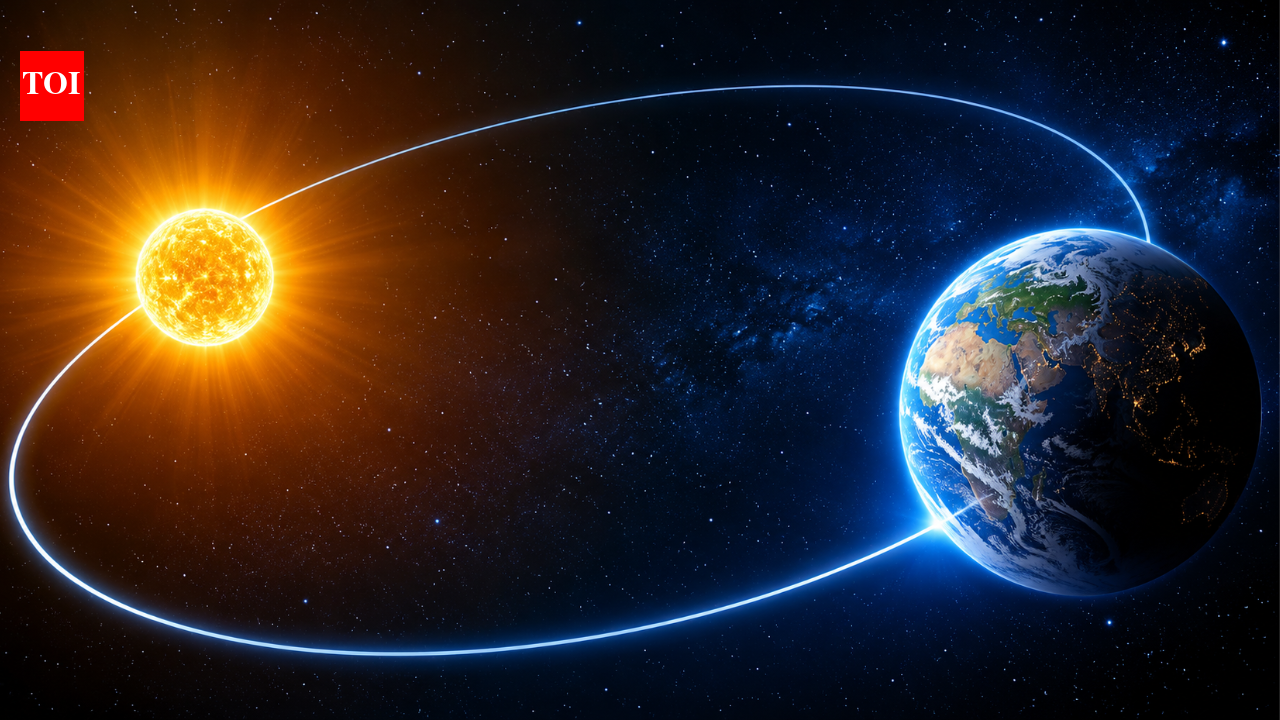
The Earth will reach its furthest point from the Sun on July 6, an annual astronomical event called aphelion. The planet is about 152.1 million kilometers from the sun, about 5 million kilometers farther than it was in early January. However, despite the distance, it will still be summer in the Northern Hemisphere and temperatures will not drop. The timing surprised many because it seemed to defy common sense. If the earth is farther from the sun, shouldn’t the earth be colder? Scientists say the answer is no. The seasons are determined not by the Earth’s distance from the sun, but by the way the Earth is tilted as it moves through space.
Why Earth’s Farthest Point from the Sun Doesn’t Cool the Summer Heat
At first glance, it seems obvious that the farther away from the sun, the colder the Earth becomes. After all, being away from a campfire can make you feel less warm.But that’s not the case in space.Imagine shining a flashlight on a wall. Stretch it straight and the light will form a bright little circle. Tilt the flashlight and the same light is spread over a larger area, making it less intense. The sun behaves similarly.During July, the Northern Hemisphere is tilted about 23.5 degrees toward the Sun. Because of this tilt, sunlight hits the ground more directly, and daylight lasts much longer than in winter. These two factors transfer far more energy to the surface than the small reduction caused by the Earth’s greater distance from the sun.That’s why even at the Earth’s furthest point from the sun, cities in much of Europe, North America and Asia still experience warm summers.
Isn’t it amazing what the Earth is doing right now?
Pause for a moment and think about where you are right now.You are standing, sitting or walking on a planet that spins on its equator at up to 1,670 kilometers per hour while orbiting the sun at an average speed of about 107,000 kilometers per hour.You can’t feel either movement.At this very moment, someone might be relaxing by a public swimming pool in Spain, Greece or Italy, soaking up the summer sun. Thousands of kilometers away, someone in Australia, New Zealand or Argentina might be putting on a winter jacket before going to work.They’re all traveling through space together on the same planet, moving at incredible speeds, but experiencing completely opposite seasons simply because the Earth is tilted.It’s one of the most elegant examples of how precisely our solar system operates.
What is aphelion?
Aphelion is the point in Earth’s orbit furthest from the Sun. This year, it happens on July 6, when Earth is about 152.1 million kilometers (94.5 million miles) away.The opposite point, called perihelion, occurs in early January when the Earth is about 147.1 million kilometers (91.4 million miles) from the sun.While this sounds like a huge difference, it’s only equivalent to about 3.3% of the Earth’s average distance from the Sun, since our planet follows an almost circular orbit rather than a highly elongated one.
Does the distance between the Earth and the Sun matter?
Yes, but far less than most people imagine.At aphelion, the Earth receives about 7% less solar energy than at perihelion because sunlight spreads over a slightly larger area. The Sun also appears about 3% smaller in the sky, although the difference is too small to be noticed by the human eye.Even so, this slight reduction will have little impact on day-to-day weather.The atmosphere, oceans and land absorb and slowly release heat, acting like a giant thermal reservoir. This natural buffering smoothes out small changes in incoming sunlight, meaning the effects of Earth’s distance are largely masked by the Earth’s tilt.
Why Southern Hemisphere Is there winter in July?
The explanation is very simple.As the Northern Hemisphere tilts toward the Sun, the Southern Hemisphere tilts away from the Sun. As a result, countries such as Australia, South Africa, Chile and Argentina experience shorter days and cooler temperatures, while much of Europe, Asia and North America enjoy summer.About six months later, the situation completely reversed.Interestingly, summer in the Southern Hemisphere occurs when the Earth is actually closest to the sun. However, because much of the Southern Hemisphere is covered by ocean, it heats and cools more slowly than land, so its seasonal temperatures are generally less extreme than many expect.
The Earth even slows down at aphelion
The Earth’s distance from the Sun also changes its speed through space.According to Johannes Kepler’s second law of planetary motion, planets move fastest when they are closest to the sun and move slowest when they are furthest from the sun.Near perihelion, the Earth moves at about 30.29 kilometers per second, or nearly 109,000 kilometers per hour. Near aphelion, the speed drops to about 29.29 kilometers per second, or about 105,400 kilometers per hour.Because the Earth moves slower in this part of its orbit, the Northern Hemisphere experiences the longest seasons of the year. Summer lasts almost five days longer than winter.
Why doesn’t aphelion set on the exact same date every year?
Although aphelion usually occurs between July 3 and July 6, the exact date varies slightly each year.Leap years, along with the gravitational pull of the moon and other planets, subtly alter Earth’s orbit. Over thousands of years, the direction of Earth’s orbit also changes through a process called perihelion precession, causing aphelion and perihelion to slowly drift across the calendar.
A perfectly balanced system now faces new challenges
The Earth’s annual orbit around the sun is a remarkable example of cosmic precision. A planet tilted only 23.5 degrees rotates around the sun at a speed of more than 100,000 kilometers per hour, creating a stable seasonal cycle that sustains life for millions of years.Today, however, this natural balance is increasingly disrupted by human-driven climate change. Global warming does not change the Earth’s orbit or its tilt, but it makes heat waves more frequent, raises average temperatures and increases the likelihood of extreme weather in many parts of the world.So when the Earth reaches its furthest point from the sun on July 6, remember that summer heat has little to do with distance. Instead, it reminds us that the seasons depend on the remarkable geometry of the Earth’s tilt, and that the climate we experience today is determined not by orbital changes but increasingly by choices humans make.