

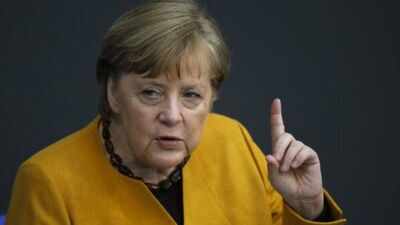
Angela Merkel This was what she said a few months before taking office as German Chancellor. In an interview with Financial Times reporters Bertrand Benoit and Andrew Gowers in July 2005, she explained her political attitude in one sentence: “A good compromise is one in which everyone contributes.“She went on to add that anyone in politics must avoid reliance on a single interest group, because such dependence is exactly what makes real compromise impossible. At the time, she was a candidate trying to convince voters that she could lead a country accustomed to chaotic multi-party coalitions rather than clean parliamentary majorities. 16 years later, when she resigned as chancellor in 2021, this line was a very effective description of how she had effectively governed three different coalition partners in four terms and some of the most contentious debates in modern German politics.
Angela Merkel’s words before becoming chancellor
Germany’s political system rarely gives one party complete control of parliament, meaning Merkel has spent her entire term as chancellor building and managing coalitions. Her Christian Democrats governed twice in four terms alongside the Social Democrats and once alongside the Free Democrats. Every arrangement requires ongoing negotiations with parties who disagree on the real substantive issues.The Financial Times interview was conducted as Merkel was still making her first bid to lead the country. In fact, she was explaining the operating principles she intended to follow. The reason this quote deserves revisiting is because her sixteen years in power fit so closely with its reality.
The meaning and explanation of Angela Merkel’s quote
Merkel’s definition of compromise is narrower than is often suggested. Many people view compromise as simply a compromise in which both sides give up something but neither side is satisfied with. Merkel described something more specific: Compromise is only good if all parties involved actually put something in, not just give something away.This distinction changes the way negotiations are judged. By Merkel’s standards, an agreement in which one side makes all the compromises and the other simply accepts the results is not a good compromise, even if it technically ends the differences. In her view, real compromise requires the contribution of everyone at the negotiating table, not just the concessions of one party.It also holds each party in the negotiation accountable, not just the party often perceived as stronger or more stubborn. A weak party that refuses to contribute anything is as much an obstacle to a good compromise as a strong party that refuses to budge. Merkel’s definition does not place blame in terms of power. It allocates it based on whether both parties actually put something into the outcome.
Sixteen years of coalition government put this idea into practice
Merkel’s coalition government has provided some of the clearest tests of this idea. Her 2005-2009 coalition with the Social Democrats, Germany’s largest alliance between two historically rival parties, forced the two sides to actually work together on policy, not just trade concessions. The same pattern repeated in her later coalitions, including decisions on the refugee crisis in 2015, when Merkel’s open stance required support from coalition partners who did not fully share her views.She did not always succeed in bringing these arrangements together. Her last coalition, formed in 2018, has been strained for years by divisions within her own camp and its Social Democratic partners. Even so, the basic mechanism she described in 2005, of demanding contributions rather than accepting unilateral concessions, remained the default approach in nearly every major decision during her tenure as prime minister.The euro zone debt crisis provides another test. Merkel must negotiate with both German voters who are wary of bailing out other countries and European partners who think Germany’s terms are too harsh. Neither side gets what they really want. Both sides need to act. In her own words, this is what makes the final agreement workable rather than simply imposed.
How to apply Angela Merkel’s quotes in your daily life
Most people negotiate much more than they realize, whether dividing responsibilities with a partner, hashing out plans with colleagues, or resolving differences with friends. Merkel’s criteria give a simple test that applies to any of these situations: did everyone actually contribute to the outcome, or did one party simply make concessions to end the discussion more quickly?Compromises that put one person in charge of all adjustments often resurface in the form of resentment after the fact, even if it seemed resolved at the time. Asking what each person contributes, rather than just what each person gives up, often results in agreements that really work.Imagine two coworkers sharing a project, with one coworker constantly taking on additional tasks to avoid conflict. This arrangement may seem peaceful for a while. It rarely stays that way. Merkel’s version of a compromise would raise a blunter question before an arrangement can be agreed: what has the other side actually put in, beyond simply agreeing to end differences.
Other quotes from Angela Merkel
- “Freedom does not mean being free from something, but being free to do something.”
- “We cannot make compromises when it comes to human dignity.”
- “It’s much better to talk to each other than to talk about each other.”
- “The question is not whether we can change, but whether we can change fast enough.”