
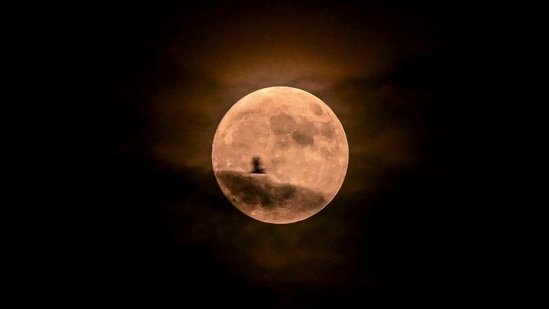
Astronomy enthusiasts from all over the world have the opportunity to witness the spectacular event in June strawberry moon Monday night. The moon reaches its maximum brightness at 7:56 pm ET, marking the first full moon of the astronomical summer.

Although many people expect it to appear bright red or pink because of its name, astronomers say the Strawberry Moon is usually the same silvery-white color as any other full moon. If it looks red, the reason is usually that it’s closer to Earth than in space.
This year’s Strawberry Moon is also a micromoon, meaning it occurs when the moon is near the furthest point in its orbit from Earth. Therefore, it appears slightly smaller than the average full moon. However, the difference is difficult to notice with the naked eye.
Read more: Why June 2026’s Strawberry Moon Is Considered the Most Powerful Moon in 100 Years
Why is the moon “red” today?
Although social media posts refer to a “red moon,” NASA says a normal Strawberry Moon does not naturally turn red.
When the Moon is low on the horizon, it usually has a red or orange appearance because the Earth’s atmosphere scatters shorter wavelengths of light.
Smoke from wildfires, dust or pollution can also enhance the effect, making the moon appear darker orange or red for a short time after moonrise.
June’s full moon follows one of the lowest paths in the northern hemisphere sky, astronomers say. Because the Full Moon is always opposite the Sun, it reflects the Sun’s lowest winter path, while the Sun itself follows its highest summer path.
According to Space.com, this creates the familiar “low-hanging moon” effect. The moon rises in the south in the east, near the horizon, and appears unusually large due to the moon illusion. This is an optical illusion caused by human perception rather than an actual size change.
As a result, atmospheric scattering creates warm orange and gold hues during the first 20 to 30 minutes of moonrise, then gradually changes to its familiar white as the moon climbs higher into the sky.
Read more: Strawberry Month 2026: 5 Important Things You Should Follow
Why is it called the Strawberry Moon?
The name “Strawberry Moon” has nothing to do with the color of the moon. According to NASA and the Old Farmer’s Almanac, it originated among the Algonquian tribe of northeastern North America to commemorate the short strawberry harvest season in June.
Other cultures gave the June full moon different names. Europeans traditionally call it the “Rose Moon,” while some Aboriginal communities call it “Thermidor,” reflecting the arrival of summer.
The Strawberry Moon is a full moon that occurs regularly every month, unlike the Blood Moon, which only occurs during a total lunar eclipse, when the Earth’s shadow paints the moon crimson. This year’s event is not accompanied by a lunar eclipse.