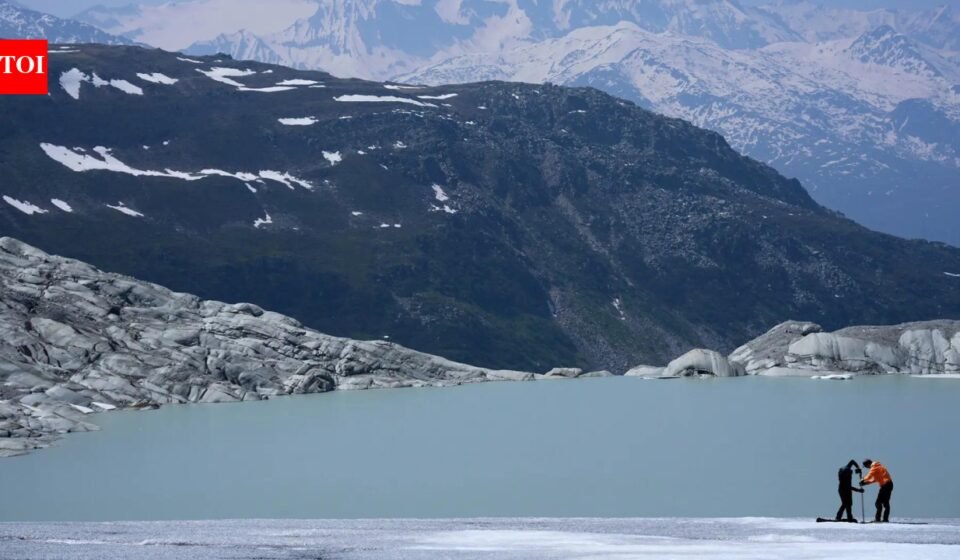

Switzerland’s glaciers are set to lose significant amounts of ice this year as an ongoing European heatwave accelerates melting, with the country expected to see a “glacier loss day” on Monday, the second-earliest date on recordThis milestone marks the moment when all the ice and snow accumulated during the previous winter melts. From then until October, each additional day of melt results in a net loss of glacier ice, further shrinking the glacier.“We are seeing huge rates of melting, melting of ice and snow all over the Alps,” Matthias Huss, head of Switzerland’s glacier monitoring center (GLAMOS), said on Friday, according to Agence France-Presse.“We’re three months too early compared to where we’re going to be healthy,” Huss added.
Heat wave accelerates melting of Alps
Since records began in 2000, the only earlier glacier loss was in 2022, on June 26. The early arrival this year is due to an intense heatwave sweeping across Europe, another spell of unusually warm weather in May and scant winter snowfall.Huss said he recently revisited the Rhone Glacier and found about a meter of ice melting vertically in just 10 days.“It’s really impressive, it’s just the effect of the heat wave,” he said.He emphasized that a heat wave was not the biggest threat. “The problem is, we have very high temperatures for a long time,” he said, adding that prolonged periods of extreme warmth are “very bad for glaciers.”
The snow conditions are not good, saharan dust The situation worsens
According to Agence France-Presse, this year’s situation is very similar to 2022, which remains the worst year for Alpine glaciers to melt on record.Hus said that Swiss glacier snowfall was about 25% lower than the 2010-2020 average. A warm May caused the snowpack to disappear earlier than usual, exposing darker glacial ice that absorbs more solar radiation and accelerates melting.He also pointed to dust blowing in from the Sahara Desert in March as another factor that worsens glacier conditions by reducing the albedo of snow.Huss said that while the full extent of the ice loss will be assessed in September, “it is now clear that we are going to have very significant ice loss this year as well.”
climate change Causes extreme heat in Europe
The melting glaciers come as scientists increasingly link Europe’s record-breaking heat to climate change.A rapid attribution study by the World Weather Attribution Group has found that the current heatwave is virtually impossible to occur without human-induced climate change, with similar events now about 200 times more likely than two decades ago.Researchers describe the unfolding event as the worst heat wave ever recorded in the region.Scientists found that when a similar event occurred in the 1970s, temperatures would have been several degrees cooler. According to the Associated Press, Europe is the world’s fastest-warming continent, with temperatures rising at about twice the global average since the 1980s.Researchers also warned that greenhouse gas emissions from burning fossil fuels continue to make extreme heat more frequent and intense, Reuters reported.
Thousands of glaciers have disappeared
Swiss glaciers have been retreating for about 170 years, but the rate of melting has accelerated dramatically in recent decades as the climate has warmed.Between 2000 and 2024, the volume of Swiss glaciers decreased by 38%.Hus said the country has lost about 1,200 glaciers over the past 50 years and now has about 1,300 glaciers left.“If climate warming continues as it has in the past few decades, by 2100 we will have only a few remnants of ice left,” he warned.Shrinking glaciers also threaten Europe’s major river systems, as meltwater from the Swiss Alps flows into rivers such as the Rhine and Rhone, causing serious long-term impacts on water supplies across the continent.