

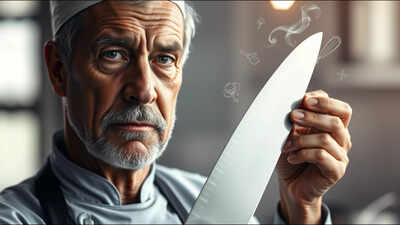
Who doesn’t know the old saying: All that glitters is not gold? In an age of performance art, where everyone is busy curating different realities on social media to go viral, we often need to be reminded of these ancient words that can bring us back to reality. The proverb “No cook walks with a long knife” appears in a collection of Russian folk proverbs translated into English in the 19th century, but its exact origin is difficult to trace. Like many traditional Russian proverbs, it comes from oral folklore rather than from a well-known author or literary work.
Collection of Russian Proverbs Vladimir Dar
The proverb probably originated in rural Russia, where occupations were easily identified by their tools. Chefs often carry large knives, just like a blacksmith carries a hammer or a carpenter carries a chisel. Over time, it was discovered that possessing the tools of a trade did not necessarily mean possessing that skill. This practical observation evolved into a proverb.This phrase appears in the major collection of Russian proverbs compiled by the famous Russian lexicographer and folklorist Vladimir Dahl. His magnum opus “Proverbs of the Russian People”, published in the mid-19th century, preserves thousands of folk proverbs collected from all over the Russian Empire.However, Dahl recorded proverbs that were already well known to ordinary people. Therefore, this proverb almost certainly predates his collection of proverbs by many generations.
Warning not to judge people by their appearance
The Russian proverb “No chef walks without a long knife” is a warning not to judge people by appearance, tools, titles or outward signs of expertise. Merely carrying professional gear does not make a person a professional. A long knife may be associated with chefs, but not everyone who carries a long knife knows how to prepare meals. This proverb reminds us that substance is more important than symbol, and ability cannot be judged solely by appearance.At first glance, this sentence seems humorous. One imagines a man striding through a village with an impressive knife hanging from his belt, eager to be mistaken for a master chef. But behind the humor lies a serious observation of human nature. Throughout history, people have often mistaken appearance for ability. Uniforms, expensive tools, prestigious titles and confident behavior can all create an illusion of competence. This proverb asks us to look deeper.
English Equivalency List
- All that glitters is not gold
- Good feathers don’t make a good bird
- Hooded monk
- Clothes do not determine a man
The wisdom of this statement makes sense because humans are naturally affected by what they see. We often think that someone who dresses like a doctor must be knowledgeable about medicine, that someone holding a camera must be a skilled photographer, or that someone who speaks confidently must know what they are talking about. While these assumptions are sometimes correct, they can also be dangerously misleading. A Russian proverb reminds us that possessing the symbols of a certain trade does not guarantee mastery of that trade.
The difference between appearance and reality
This proverb also talks about the difference between appearance and practice. A true chef is not defined by the knife he carries, but by the meals he prepares. His skills are proven through years of study, mistakes and experience. He understands ingredients, techniques, timing and flavor. A knife is just a tool. Without knowledge and practice, the tools themselves mean very little.This lesson applies to almost every career. Owning an expensive guitar does not make a person a musician. Buying running shoes does not make someone an athlete. Being able to use complex software does not make someone a programmer. In each case, visible objects may suggest expertise, but true expertise comes from dedication, discipline, and experience.This proverb also warns people not to deceive themselves. Sometimes people themselves come to believe that having a symbol of success equals success. Students may buy stacks of books and imagine that learning has already begun. An aspiring writer may focus on purchasing laptops, software, and office equipment at the expense of the actual work of writing. A person may be more interested in looking successful than being successful. A Russian proverb gently mocks this tendency.
Lessons on humility
At the same time, this proverb encourages humility. Real experts usually know how much they still have to learn. They often care less about showing off their tools and more about improving their craft. A chef rarely needs to advertise his knives. His reputation depends on the quality of his food. Likewise, a true scholar is known for his knowledge, a true athlete is known for his performance, and a true leader is known for his actions.Another interesting aspect of this proverb is that it emphasizes results rather than claims. In many areas of life, people can make impressive claims about their abilities. They may describe themselves as experts, innovators, visionaries, or experts. But words alone are not enough. This proverb raises a simple question: Can they really get the job done? The chef has to cook. The carpenter must build. Teachers must teach. Performance is the ultimate test.
encourage critical thinking
This statement also has implications for how we evaluate others. It encourages critical thinking and careful judgment. We should not be fooled by appearances but should seek evidence of skill and character. When hiring employees, choosing leaders, choosing advisors, or building friendships, it’s wise to look beyond superficial metrics. The person with the most impressive appearance is not necessarily the most capable person. Sometimes, the truly skilled are the quiet ones who let the results speak for themselves.“Who is not the chef who walks with a long knife” tells us that reality is more important than appearance. Tools, titles, uniforms, and displays of confidence can all make an impression, but they cannot replace real knowledge and skills. A knife cannot make a chef any more than a crown can make a king or a diploma can make a scholar. What matters is the ability to perform tasks, meet challenges and produce results. This proverb invites us to become keen observers of the world and honest judges of ourselves. We should not focus on the appearance of ability, but should strive for the ability itself. A long knife may catch the eye, but it’s the meal that proves the chef. This simple insight explains why this ancient Russian proverb still resonates centuries after it was first uttered.