
In the shallow, churning waters off the Philippine coast, a long-forgotten wartime story is brought back to view, not through ritual or land excavation, but through the slow, patient work of sonar scanning and archival excavation. What began as a search based on scattered wartime records led to the discovery of the identity of a Japanese transport ship believed to have carried more than a thousand Allied prisoners during the final stages of the Pacific War. The ship, known as the Fukufuku Maru, has virtually disappeared for decades amid conflicting reports and uncertain coordinates. Its rediscovery is at the center of a television investigation involving an underwater team, historians and divers, and captured footage for an upcoming season of the Discovery Channel show. The discovery is seen less as a spectacle and more as a restoration of place and context, a fixed point in a history that has drifted for eighty years.
1944 shipwreck becomes decades-long archival mystery
The ship itself was part of a network of so-called “Hell Ships,” a grim wartime system of cargo ships and passenger ships repurposed to transport prisoners within Japan’s wartime confines. Conditions were notoriously harsh, but beyond that, documents were often fragmented, destroyed, or simply misrecorded in the chaos of the war’s final years. Fukufukumaru slipped into the gap.According to the Naval History and Heritage Command, the ship was sunk in September 1944 during an Allied attack on the convoy, records show, but the exact location of the sinking remains uncertain. Different wartime records place the wreck in slightly different locations, differences enough to throw later searches off target by miles. Over time, assumptions gradually become accepted facts, even as certainties quietly erode.The turning point occurred not underwater but in archives and digitized military archives. Researchers working with the Hellship Memorial Foundation began cross-checking Japanese convoy logs with Allied attack reports. In the process, they discovered details that suggested large deviations in long-term coordinates.
Hōfuku Maru confirmed to lie beneath 160 feet of silence and seafloor sediments
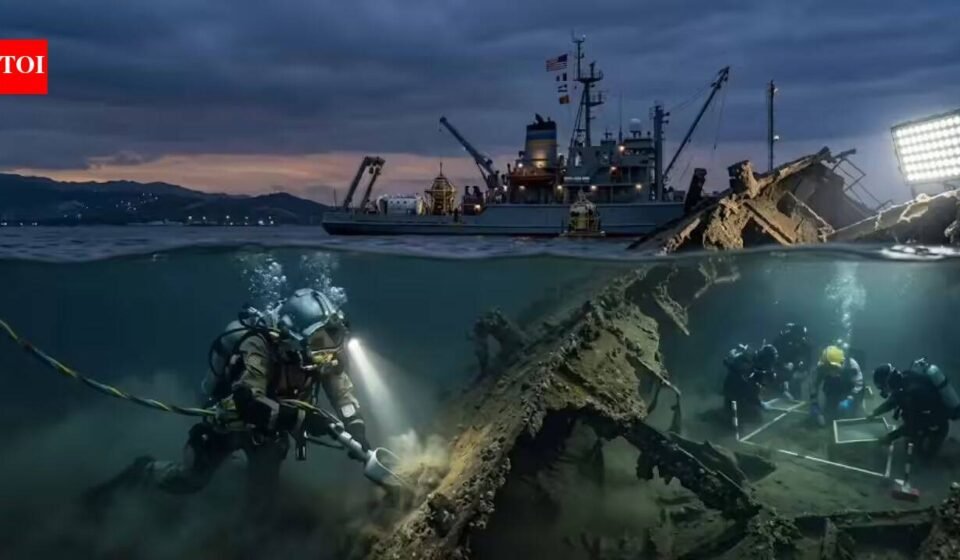
According to Warner Bros., the search team eventually located the unidentified wreckage at approximately 160 feet. Discover press releases. At first it was just a twisted silhouette, half-buried in sediment and marine life. Then, a clearer structure emerged: the hull was divided into sections, and the mast collapsed in a way that suggested sudden violence rather than gradual decay.Divers confirmed the sonar hints. The ship’s dimensions match the wartime schematics associated with the Hōfuku Maru, including the proportions of the cargo holds and deck layout. Photogrammetric work was used to align the wreck with historical blueprints, narrowing uncertainties through repeated comparisons until there was little room for doubt.Among the wreckage, human remains were also observed, a detail that moves this find from purely maritime archeology to the more important category of war grave restoration.
In search of forgotten things in modern times hell ship
The field trip was led on camera by Josh Gates, working alongside underwater imaging experts and marine archaeologists who have spent years mapping wartime shipwrecks in the Pacific. Their role is not simply to locate the site, but to verify layeredly: structural form, material decay, and locational consistency with archival data.Much of the technical confirmation relied on modern imaging systems, including high-resolution seafloor mapping and 3D reconstructions of damaged parts of the wreck. The fact that the ship appears to have split into two parts is consistent with historical accounts of its destruction, adding another intersection between record and reality.The work was filmed as part of an “expedition into the unknown,” which is increasingly turning to historically based searches, blending exploration with archival investigation.
the Philippines ‘ Deepening role in the Hell Ship recovery operation
The Naval History and Heritage Command reported that the identification of the “Bofukumaru” did not occur in isolation. Similar efforts continue elsewhere in the Philippines, where agencies such as the U.S. government’s Defense POW/POW Accounting Service have been involved in finding and salvaging similar wrecks, including the Dairyoku Maru in Subic Bay.The ships, which often transported convicts in undocumented conditions of the time, have become the focus of modern recovery efforts. Each confirmed location adds another fixed coordinate to the wartime map that had been deliberately obscured or later lost due to inconsistent record keeping.