
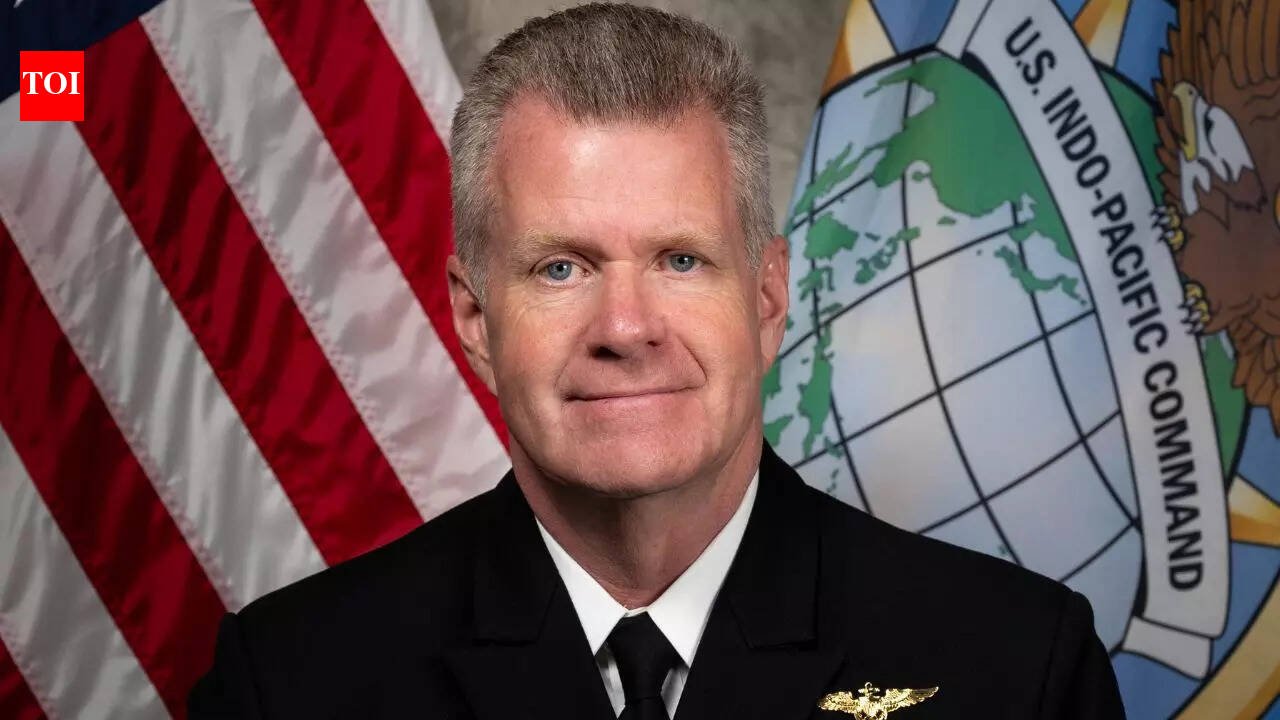
New Delhi: Gen. Samuel J. Paparo, commander of the US Indo-Pacific Command, “praised India’s tactical execution during military operations against Pakistan” during his visit to India on Sunday. operation sindor And said “there are always lessons to be learned from every conflict in the world.”He said the U.S.-India defense relationship is on a “dramatic upward trajectory,” even as he expressed concern about increasing “coercion” and “aggression” in the Indo-Pacific region.
Replying to a query from TOI about his views on the Sindoor operation, the US commander, who was interacting with a select group of journalists, said: “First of all, I have the utmost respect for the horrific events (Pahalgam terror attack) that happened before the crisis. In discussions with partners, I appreciated the tactical execution (of the operation). We also sincerely commend the restraint shown. We want to work together to ensure that horrific events like this never happen again.The general also said he saw the Indian military’s strong commitment to learning lessons from the conflict.Asked what lessons the United States learned from Operation Sindor, in which Pakistan used Chinese weapons, General Paparo said, “Sophisticated long-range weapons with complex long-range kill chains.” With the “combination of 21st century sensors, communications, thrusters, warheads, and seekers, geography is no longer a commodity…”Regarding China’s growing military strength, the admiral, who is responsible for all US military operations in the region, said, “Deterrence is our highest duty. My job is to think about the worst-case scenario and prepare for it. India also has some concerns in the Indo-Pacific region, as the region is home to 60% of the world’s population, more than 60% of the world’s GDP and seven of the world’s largest militaries.“We address these issues through an evolving partnership…a mutually respectful sovereign relationship between the world’s oldest democracy and the world’s largest democracy,” he said, adding that the United States and India were both committed to the principles of sovereignty, freedom of navigation and freedom of the seas.“We commend India for its tremendous contributions to the security of the Indian Ocean region,” he said. The two sides also considered strengthening maritime security cooperation, including cooperation in the field of undersea domain awareness.Considering the upcoming Milan Exercises, Admiral Paparo said, “It is good to see the deepening of the Indo-US defense partnership, as reflected in the defense agreement recently signed by US Secretary of War Pete Hegseth and Indian Defense Minister Rajnath Singh in Kuala Lumpur. A series of joint exercises and personnel exchanges such as Exercise Yod Abhayas in Alaska, Exercise Milan, Malabar Series, COPE India and Tiger Triumph Series and personnel exchanges are strengthening the relationship between India and the United States.” We cherish this relationship. “Regarding modern warfare strategy, the admiral said, “The 21st century will increasingly be dominated by actors who master the information environment, namely space, counterspace, electronic warfare, low observability and other technologies.”At the Artificial Intelligence Summit to be hosted by India, he said: “Prime Minister Modi’s visionary Artificial Intelligence Summit. I celebrate India’s vision on how to leverage artificial intelligence in the 21st century. Artificial intelligence has many connections with defense, and the U.S. Indo-Pacific Command is at the forefront of defense applications of artificial intelligence.”