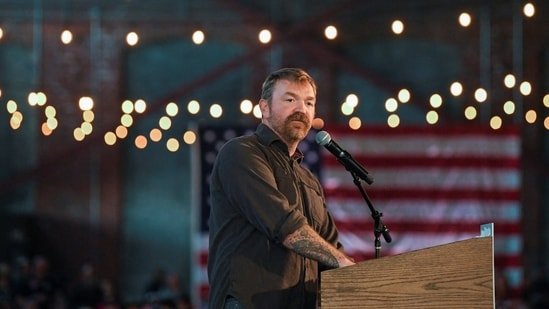
Graham Plattner has endured more scandals in six months than many politicians endure in a lifetime. A Senate candidate from Maine (pictured) has faced controversy over tattoos linked to Nazism and his past bigoted social media posts. Now he’s in trouble for explicit messages he apparently sent to women on Kik, a messaging app with a relatively young user base that’s often associated with sexting. Mr. Plattner is married, and it was his wife who alerted his campaign to the behavior last year, fearing it could become a political liability.
In seven polls conducted this year, Mr. Plattner faced Republican incumbent Susan Collins, with him leading by an average of 7.7 percentage points. (Reuters)
This puts Democrats in an awkward position. Until recently, Mr Plattner appeared to have secured the party’s nomination. His primary challenger, two-term Democratic Gov. Janet Mills, suspended her campaign in April. However, on June 1, she posted for the first time on the campaign’s X account, sparking speculation that she might reenter the race ahead of the party’s June 9 primary. The impact extends beyond that game. Maine is one of four seats Democrats may need if they want to regain control of the Senate in November.
Mr. Plattner’s candidacy raised hopes that this was possible. In seven polls conducted this year, Mr. Plattner faced Republican incumbent Susan Collins, with him leading by an average of 7.7 percentage points. The 41-year-old Marine infantryman-turned-oyster farmer has weaved an outsider narrative that appeals to voters across the political spectrum who are angry at the economic and political elites. In a campaign video, he forged a close bond with a three-time Trump voter over their shared belief that Bernie Sanders, the socialist senator from Vermont, was denied the Democratic presidential nomination by “the establishment” in 2016. In the speech, he painted Ms. Collins as out of touch with the Miner working class, beholden to corporate interests and too willing to accommodate Donald Trump.
Voters seem to consider Mr. Plattner one of their own, whatever his flaws. He was convincing when he said he didn’t know the meaning of his tattoo (because it was covered up) because he got it while on leave with his fellow Marines. as he explained that his controversial social media posts were written during a period of alienation and depression following combat service. But not everyone is convinced. Recently, as Plattner’s staff prepared a podium at a gas station to speak on a proposal to repeal the federal gas tax, a passing motorist yelled, “He’s a fucking Nazi!” After a while, another driver stopped, jokingly gave a Hail salute and said he wouldn’t vote for “a non-Nazi boy.”
The latest charges may be harder to dismiss. One Kik account apparently belonging to Platner included a profile photo of a shirtless man with a towel wrapped around his waist, posing in a mirror and with tattoos that appeared to match the candidate’s. A campaign official told The Economist that Mr Plattner downloaded the app when he was single, that it had long since been deleted from his phone and that he had not messaged anyone under 18. “Anyone who suggests otherwise,” the official added, “is lying.”
Ms. Collins is in many ways the polar opposite of Mr. Plattner: a cautious moderate political veteran who is 32 years his senior. She is also very resilient. For nearly three decades, she survived in a state that hadn’t voted for a Republican presidential candidate since 1988. To do this, Ms. Collins relies on Democratic support, typically winning 10-15% of the vote. She’s in three of the eight states where Republican senators have outperformed since 2008, according to our analysis, which takes into account a state’s partisanship and the national political environment.
Over the years, Democrats have tried nearly every type of challenger against Ms. Collins, from members of Congress to lawyers with the American Civil Liberties Union. In 2020, then-Maine House Speaker Sara Gideon lost by eight percentage points despite beating Collins by a two-to-one margin on spending. “I think people want to try something different this year,” said Toby McGrath, a Democratic-leaning strategist in Maine.
Many voters are yet to realize that the election is still five months away. Supporters of Ms. Collins pointed out that 2020 polls consistently underestimated her, showing her trailing Ms. Gideon, even though she ultimately won handily. The difference may be due in part to the difficulty pollsters have in reaching low-propensity voters, a large number of whom supported Trump. Without his name on the ballot this time, Ms. Collins may not benefit from the same turnout boost.
In May, the two candidates released their first ads as the general election race took center stage. Mr. Plattner’s ad accused Ms. Collins of betraying working-class voters. Ms Collins highlighted her success in securing funding to repair the breakwater which collapsed in 2014. The contrast between the two could not be starker. With each new scandal involving Mr. Plattner, the situation becomes more serious.