
Most robots are designed to look like something. For decades, engineers designing machines to navigate the real world have reached the same reference points: the human skeleton, the four-legged trot of a dog, the crawl of an insect. These biological templates have produced impressive machines, but they come with an embedded assumption that robots need a front, a back, and a preferred direction of travel. A team at Duke University’s Universal Robots Laboratory has now directly challenged that assumption, with the result being a machine that looks unlike anything in the robotics catalog and, more importantly, moves unlike anything that has come before it.
Duke’s omnidirectional robot has no front and no back
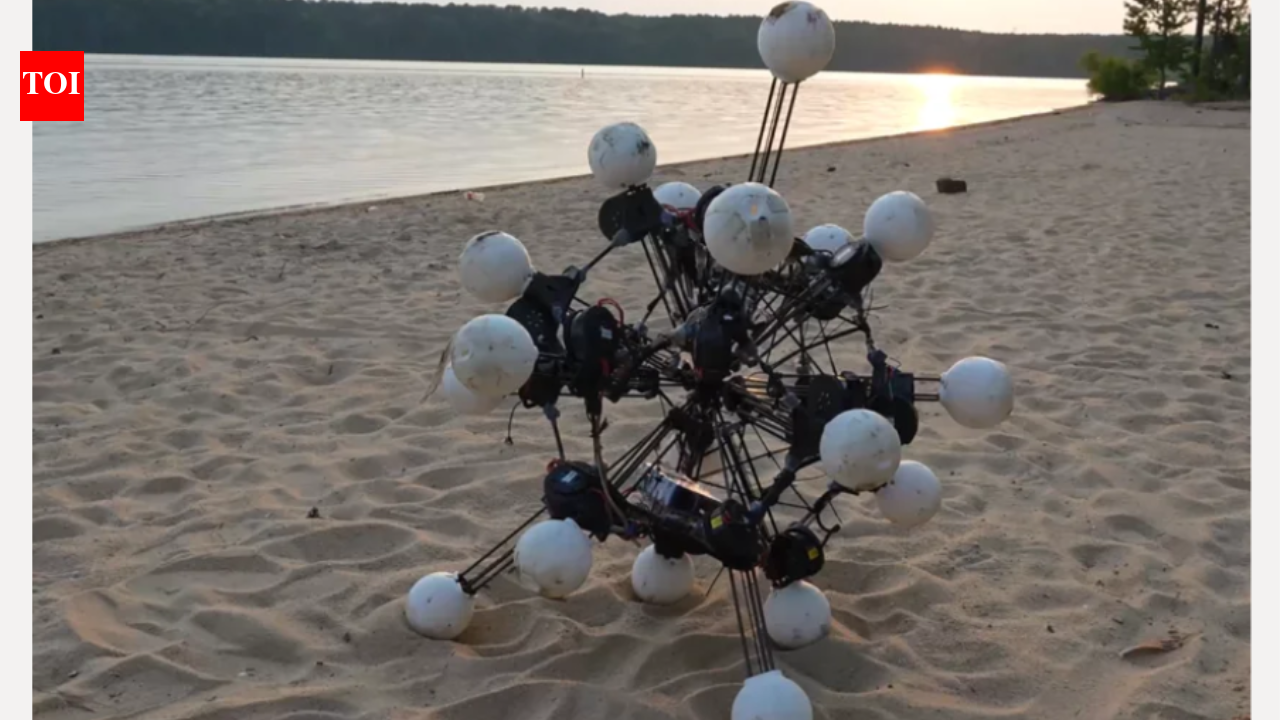
The robot is named Argus, after the all-seeing giant from Greek mythology, which is also a fitting name. It has 20 modular telescoping legs radiating out from a central core, with a depth camera mounted on the tip of each leg, giving it a near-complete spherical field of view. No front, no back, no top, no bottom. It can walk, roll, climb, stabilize and manipulate objects in any direction without first turning or reorienting. The work, led by engineering professor Boyuan Chen, doctoral student Jiaxun Liu and postdoctoral researcher Boxi Xia, has been published in the journal scientific robot.
The design principles behind Argus and what it actually measures
The conceptual basis for Argus is a design principle developed by the team called dynamic isotropy. The principle asks not what a robot should look like, but how uniformly it accelerates in all directions in space. The team quantified this as a score from 0 to 1, where 1 represents a theoretically perfect machine that can push in any direction with exactly the same force. According to published research, the most advanced robots in use today, including state-of-the-art quadruped robots, humanoid robots and traditional drones, score below 0.6 on this metric. The Argus score is 0.91, which is close to the theoretical upper limit. As Chen says: “When a robot can accelerate equally well in all directions, it no longer needs to face the world in any particular way. Forward and backward become the same.” Left and right become identical. The whole problem of robot control changes character. “
Why Argus’s dodecahedral geometry produces near-perfect motion symmetry
To reach a score of 0.91, you first need to solve a geometry problem. The team ran more than 1,500 simulated robot configurations to determine which leg arrangement was closest to its theoretical maximum. The winning design placed 20 identical cable-driven legs at the vertices of a dodecahedron, a three-dimensional geometric solid with 12 pentagonal faces. This arrangement produces nearly perfectly uniform force distribution and visual coverage in all directions. Each leg is telescoping and cable-driven, meaning it can extend and retract to push against surfaces, and each leg carries its own depth camera so the robot’s perception matches its physical range in every direction simultaneously. It’s no coincidence that the result looks less like a machine and more like a sea urchin. The study clearly points to this similarity, which is based on the same geometric principles that give sea urchins their remarkable mechanical consistency.
Argus traversed forests, sand and wet surfaces in real-world testing
Building a robot that performs well in simulation is one thing; The Duke team tested Argus extensively in the real world, running it on the Duke campus and surrounding terrain. According to the study, the Argus rolled on concrete, grass, dense foliage, soft sand, wet surfaces and tree bark without losing stability regardless of its orientation. It clears obstacles five inches high. It climbs vertically between two closely parallel walls by alternating support and thrust with different subsets of its legs. It carries a ten-pound payload at near full speed and propels a large cube through space while constantly rolling. “When we first saw it navigating through trees and rough terrain, even in the event of a violent collision, we knew this was something different,” said doctoral student Jiaxun Liu, co-first author of the paper.
How Argus keeps moving despite a broken leg or motor failure
One of the more practical findings from the study is the robot’s resistance to damage. Because each of its 20 legs contributes only a small portion of the total motion, and because the design distributes force evenly rather than relying on a few key limbs, the Argus can continue to function even if one or more motors fail, or a leg breaks. This is no small advantage. Most robots with fewer limbs face significant performance degradation or complete failure when they lose key joints. Argus’s architecture makes it structurally tolerant of partial failures, reflecting the same mathematical principles that make it omnidirectional: nothing would destroy the system more than losing it.
The future of robotics beyond biological design templates
The team made it clear that Argus is a proof-of-concept rather than a finished product, but the impact on robot design is huge. Postdoctoral researcher Xia Boxi noted that the robot proves that dynamic symmetry is more than a theoretical exercise; it produces a deployable machine that can handle real-world challenges. Chen describes Argus as the first member of what he envisions as a broader family of dynamically symmetric machines: “Robots don’t need to imitate dogs or humans to be agile, tough and useful.The researchers also modeled designs with up to 40 legs that scored even higher for dynamic isotropy, but these designs are currently still impractical as prototypes given the added mechanical complexity. However, Argus’s dodecahedral architecture sits at a useful inflection point, complex enough to approach a theoretical ideal and simple enough to actually be built and tested in the field.