
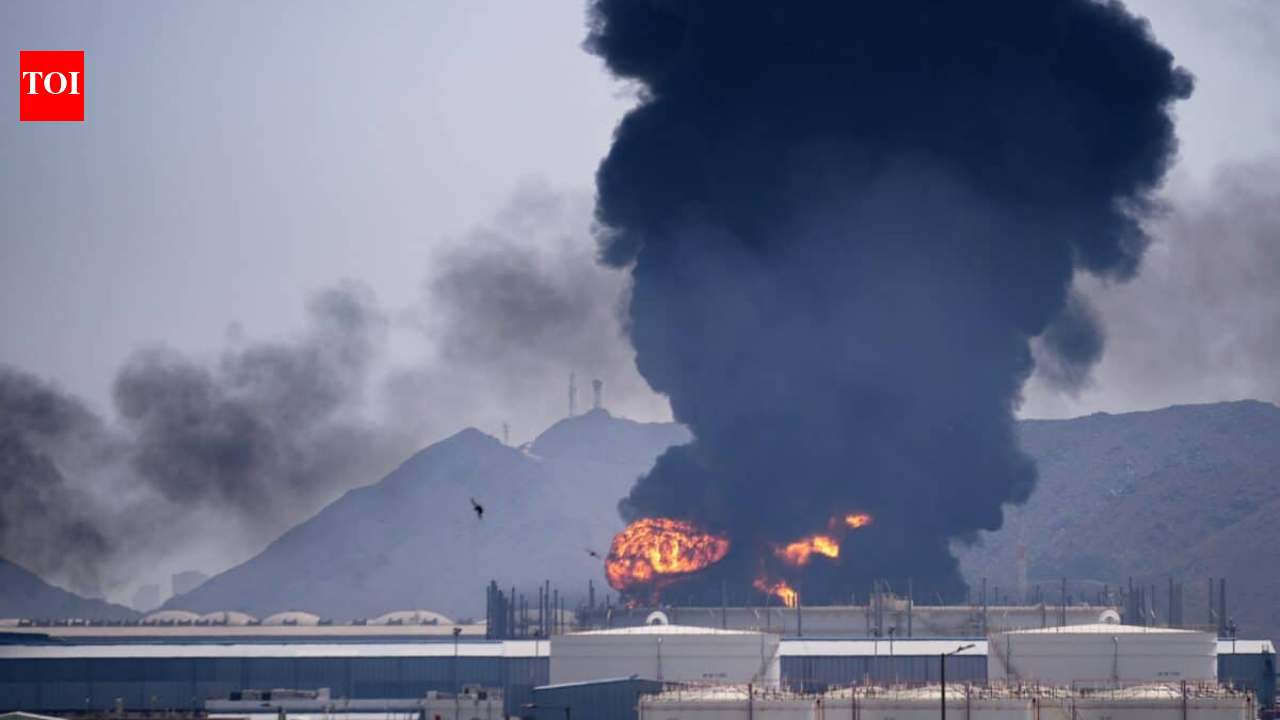
Tensions in West Asia escalated sharply on Monday, with Iran’s Islamic Revolutionary Guard Corps (IRGC) saying it had targeted U.S. military bases and Washington announcing new attacks on Iranian military facilities.The location of the base was not specified in statements broadcast by Iran’s Islamic Revolutionary Guard Corps and other Iranian state media.Kuwait’s military said its air defense systems were responding to drone and missile attacks. “Kuwaiti air defense systems are currently under attack from enemy missiles and drones,” the Army said in a post on
US launches new round of strikes against Iran
U.S. Central Command (CENTCOM) said it carried out self-defense strikes on Iranian radar and drone command and control sites following what it called “an act of Iranian aggression.”According to Central Command, the attacks targeted radar and drone control facilities on Iran’s Goruk and Qeshm Islands. A US MQ-1 drone flying over international waters was reportedly shot down in an operation that took place on Saturday and Sunday (local time).Central Command said U.S. fighter jets responded “promptly” to the incident, destroying “Iranian air defense systems, a ground control station and two unidirectional attack drones,” which it said posed a “clear threat” to ships transiting the region’s waters.The command described the action as “well thought out” and stressed it was in self-defence.“No U.S. service members were harmed,” Central Command said, adding that it would continue to safeguard “U.S. assets and interests in response to unjustified Iranian aggression during the ongoing ceasefire.”
Iran’s account of drone incident
Iran disputes the U.S. version of events. Iran’s Revolutionary Guards said its air defense forces shot down a U.S. MQ-1 drone it said entered Iranian airspace early Sunday morning, the semi-official Tasnim news agency reported.The statement said the drone was detected by Iranian surveillance and air defense systems and subsequently became the target of advanced anti-aircraft missiles. Iranian authorities claimed the plane had been successfully destroyed.Iran’s Revolutionary Guards said the drone belonged to the U.S. Army and said it was shot down because it entered Iranian airspace “with the intention of conducting hostile acts.”
Older swapping attack
The latest developments come just days after the two sides again turned on each other. Iran’s Revolutionary Guards previously said that after the United States launched a new round of attacks in southern Iran, it targeted a U.S. air force base in the region.Iran’s missile launch came after the United States shot down an Iranian drone in the Strait of Hormuz and attacked a military base in Iran’s southern strategic port city of Bandar Abbas.Iran’s Islamic Revolutionary Guard Corps said the attack on a U.S. air base occurred in the early hours of Thursday morning and targeted the “source” of earlier U.S. attacks on Iran, Iran’s Islamic Revolutionary Guard Corps reported.
Diplomacy continues amid tensions
While indirect talks continue between Washington and Tehran on a possible deal to end the three-month conflict, renewed military exchanges have raised concerns about the stability of the fragile ceasefire.US War Secretary Pete Hegers warned that military operations could resume if any deal failed to meet Washington’s demands.“Our inventory is ideally suited for this,” Hegseth declared in a speech in Singapore.President Donald Trump has reportedly sent back a separate proposed deal with Iran for further modifications. The US president also said he was “in no rush” to finalize a deal. According to CBS News, citing Axios, Trump requested multiple changes during Friday’s meeting and later sought further changes.Iranian Foreign Minister Abbas Araghchi urged caution over reports of the talks, saying: “Until conclusions are drawn… everything said now is speculation.”Iranian media reported that diplomatic negotiations are still ongoing, and both parties continue to propose modifications to the draft agreement.
Missile infrastructure restored
Meanwhile, Iran has restored much of its underground missile infrastructure to service after months of excavation and repair work, CNN reported. The development highlighted “the limitations of the U.S. bombing strategy,” which focuses on sealing tunnel entrances, the report said.The latest military action has heightened concerns that the ceasefire could collapse despite ongoing diplomatic efforts by Qatar and other regional actors.