
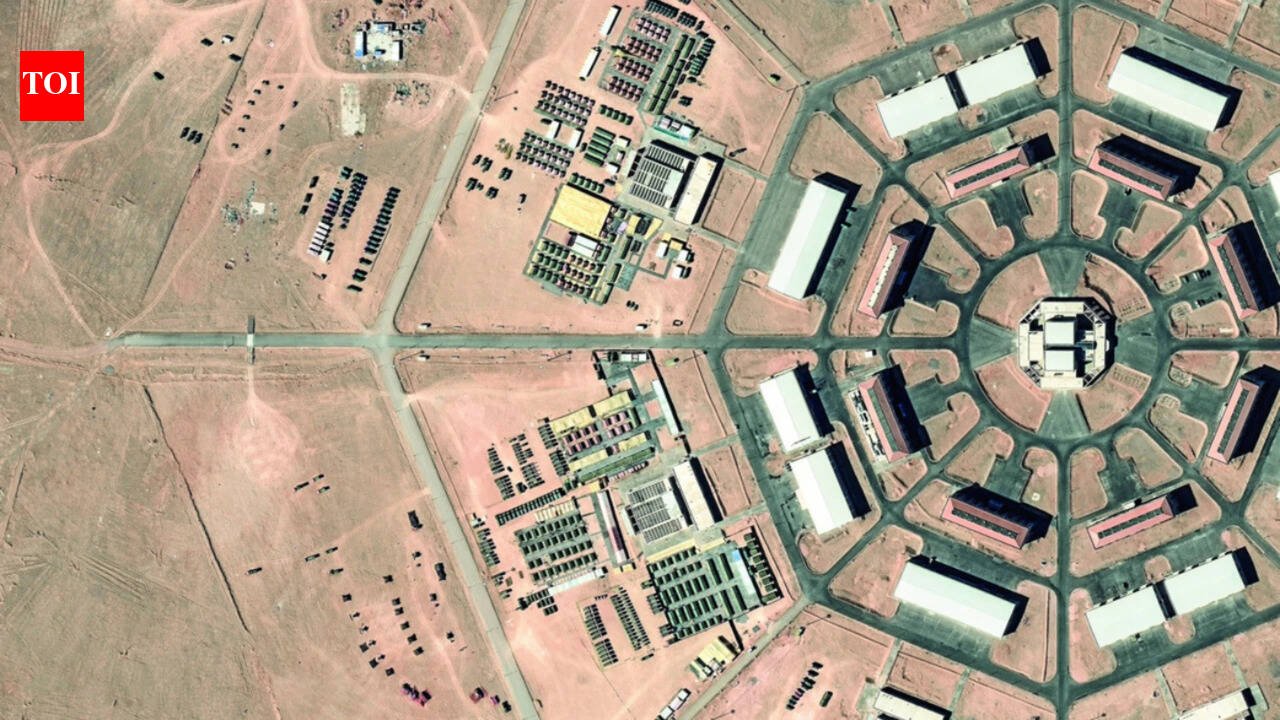
A vast military complex is taking shape in China’s remote deserts, and some security scholars say it appears to be built to ensure that a U.S. first strike against China’s nuclear arsenal cannot reliably destroy Beijing’s counterattack capabilities. China’s nuclear missiles can already reach any American city. Now, satellite images show Beijing is building a vast network of launch pads, bunkers and communications nodes near isolated nuclear silos that house the Chinese military’s longest-range missiles.The ability to protect its desert silos is key to China’s stated goal of establishing a minimum but credible nuclear deterrent – a policy based on the ability to retaliate if struck first. Although People’s Liberation Army The PLA can launch nuclear weapons from submarines and aircraft, and silos in the northwestern Xinjiang region and Gansu province are the core of its nuclear forces.The cornerstone of China’s principles is the “no first use” policy. Xi Jinping this month warned US President Donald Trump that if the two countries mishandled Taiwan, which China claims as its territory, it could lead them to a “dangerous place”.Octagon in the desertThe new desert infrastructure is centered on two octagonal facilities built over the past six years in eastern Xinjiang. Both are located on the southwest side of the Hami nuclear silo area, one is about 140 kilometers away from the Hami nuclear silo site, and the other is about 230 kilometers away. Pictures show drills involving large military vehicles taking place in the northern Octagon area between this month and April.Satellite images show the octagonal structure contains housing for personnel and large military vehicles. They are flanked by armored bunkers and fortified weapons storage areas, as well as airfields and rail terminals connecting the Octagon and Hami Silos.Five security scholars interviewed by Reuters agreed that this infrastructure could broadly support China’s nuclear program and other military purposes. But they warned that key details remained unclear, including what weapons China might deploy at the launch pad and whether the octagon would house truck-loaded ballistic missiles or a facility to install nuclear warheads.U.S. officials and arms control analysts say China is expanding and improving its nuclear weapons capabilities faster than any other country. The latest Pentagon report on China’s military modernization says China’s warhead production has slowed but it is on track to deploy 1,000 warheads by 2030. Reports in December estimated that China may have loaded 100 intercontinental ballistic missiles (ICBMs) into its three main silos.U.S. officials said China has also been strengthening its early warning system. According to the Pentagon, the system can detect an incoming ICBM within 90 seconds of launch and alert a command center within three to four minutes — enough time for China to launch its own silo weapons before being hit.National defense makes China uniqueRemarkably, each octagon is at the heart of a network of dirt roads and pipelines that stretches deep into the desert. These routes connect to concrete pads. Three security scholars said the launch pads could be used to deploy mobile anti-aircraft missiles, electronic warfare nodes, or some of the larger road-mobile intercontinental ballistic missile launchers. Hans Christensen, director of the Nuclear Information Project at the Federation of American Scientists, said that while it was difficult to tell how various devices would be used, it was “hard to rule anything out.”The extent of its defense network near its silos could set China apart from other major nuclear powers. Christensen said the U.S. and Russia, which have far more warhead inventories and fielded weapons than Beijing, rely on large numbers of silos, relatively isolated silos and hardened buildings to deter a first strike rather than broad missile defenses. “I’ve never seen anything like this,” Christensen said. “This is an extraordinary effort.”(This is a Reuters report)