
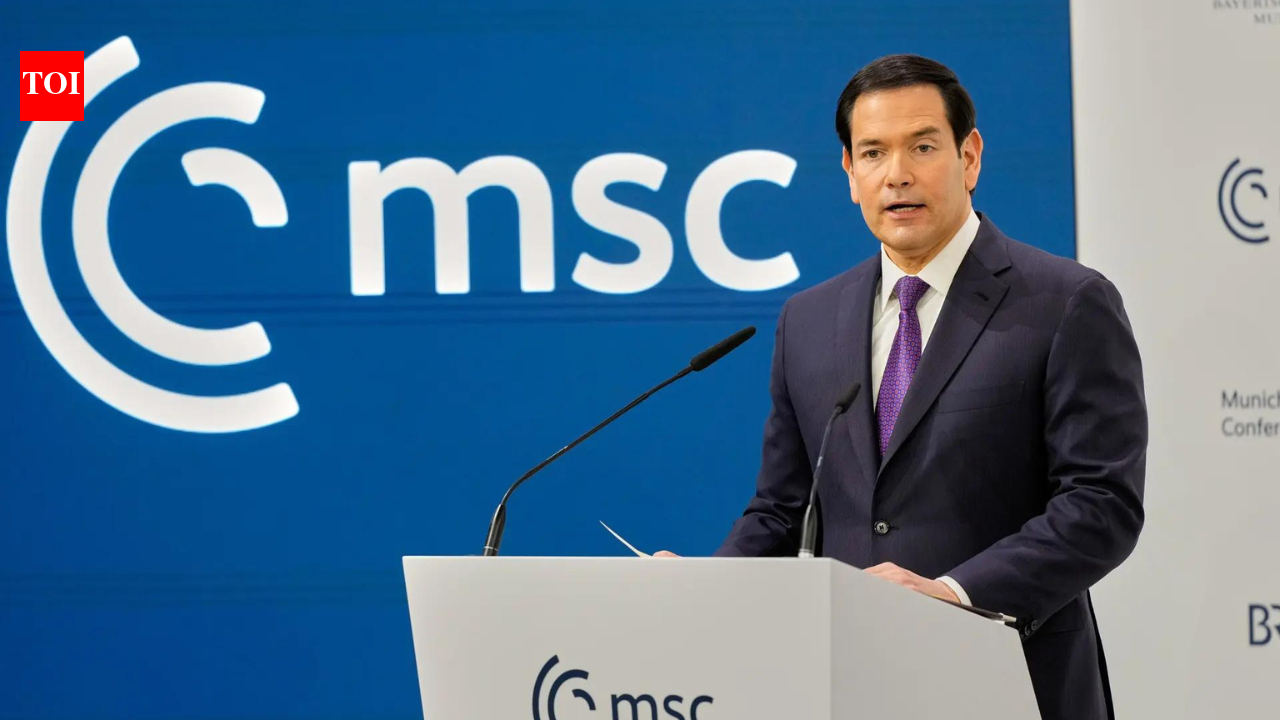
US Secretary of State Marco Rubio speaks at the Munich Security Conference in Munich, Germany (Image: AP)
U.S. Secretary of State Marco Rubio on Saturday questioned Russia’s sincerity in ending the war in Ukraine, as Washington pushes for a quick peace deal.Speaking at the Munich Security Conference, Rubio said Moscow’s willingness to negotiate remained unclear as the conflict entered its fifth year.
“We don’t know if the Russians really want to end the war,” he was quoted as saying by AFP.His comments come as a new round of talks between Russian and Ukrainian envoys brokered by the United States is scheduled to take place in Geneva next week.The discussions, confirmed by the Kremlin and Ukrainian President Volodymyr Zelensky’s communications adviser, came just days before the fourth anniversary of Russia’s full-scale invasion.
The war continues in diplomacy
The diplomatic efforts come against a backdrop of ongoing fighting. A Russian drone strike in Odessa hit a residential building and killed one person, officials said Saturday. Meanwhile, a Ukrainian missile attack killed two people and injured five others in the Russian border city of Belgorod.Previous U.S.-led efforts, including two rounds of talks in Abu Dhabi, have failed to bridge differences on key issues such as the future of Ukraine’s Donbass region, which remains largely under Russian control.
Let Europe rest assured
In Munich, Rubio also sought to calm European concerns about the transatlantic relationship under President Donald Trump.“We are not seeking division, but rather reviving ancient friendships and reviving the greatest civilization in human history,” he said. “What we want is to revive alliances.”“We want Europe to be strong. We believe Europe must survive,” Rubio added, stressing that the United States and Europe “belong together.”He acknowledged Washington’s tone may have been harsh but said it reflected allies’ demands for “seriousness and reciprocity,” according to the Associated Press. “At a time when headlines herald the end of the transatlantic era, let it be clear to all that this is neither our goal nor our desire,” he said.Rubio also criticized global institutions, saying the United Nations has played “little to no role” in resolving major conflicts, including the war in Gaza.His speech, which took a softer approach than last year’s speech by U.S. Vice President Vance, came as European leaders called for renewed trust and greater defense responsibilities within NATO, with the war in Ukraine becoming a focus of discussion.