Special Xi-Xi meeting: Experts explain the secret power game in the first handshake during the visit to China

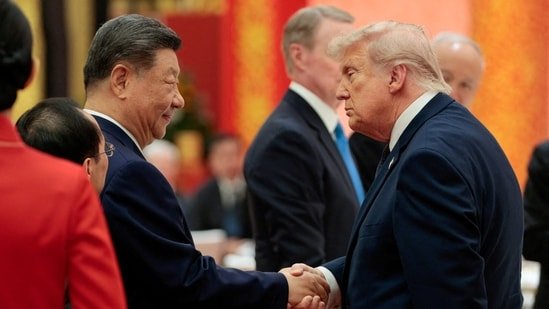
President Donald Trump and the President of China Xi Jinping They discussed several global issues at the closely watched Beijing summit. However, the moment that impressed several experts was the “strong” handshake between the two leaders.

The two met on Thursday morning at the Great Hall of the People in Beijing, where Trump was welcomed with a formal state ceremony complete with military honors, waving flags and rows of schoolchildren on the red carpet.
But body language suggests the real story may have unfolded in the first few seconds of their interaction.
Experts focus on the 10-second handshake
Trump and Xi shook hands for about 10 seconds before the US president extended his left hand and tapped Xi several times – a move that experts said either showed enthusiasm or was an attempt to establish dominance.
“Trump did not use his usual ‘yank’ handshake in this meeting, which he typically uses to assert dominance,” psychologist and former Oxford University professor Peter Collett told Newsweek.
Collett noted that Trump’s signature greeting, which typically involves pulling leaders closer or using the other hand to strengthen the handshake, was significantly weakened during his meeting with Xi.
Collett added: “There seem to be two situations in which he would not do this – either there is no need to be bossy, or he considers the other party to be his equal, or at least does not want to disturb the illusion of his view of them.”
Xi Jinping’s restrained response
Experts also noted Xi’s calm demeanor during the greeting, saying the Chinese leader acted cautiously and restrained throughout the exchange.
“When Trump arrived, he walked over to Xi Jinping, and even though he was the host, he made almost no effort to walk over to Trump or express any enthusiasm for the upcoming meeting,” Collett said. “It gives the impression that Trump is doing all the work, both literally and figuratively.”
Read more: Why Trump’s negotiated $10 billion settlement with IRS raises alarm
According to reports, Trump was the one who initiated the handshake after walking from the motorcade onto the red carpet outside the Assembly Hall.
Body language analysts note that it is the leader of the host country who traditionally initiates such greetings, making Trump’s aggressive approach particularly striking.
Trump showed unusual seriousness
Body language expert Lillian Glass also observed Trump displaying a more serious and focused expression during the summit.
“Trump leaned toward Xi Jinping and showed warmth and intimacy,” Glass told the Mirror.
She added: “We don’t see this expression from Trump very often. It shows that this is one of the most serious visits he’s going on and he’s not taking it lightly.”
“Trump seems to have found his match”
Collett said the exchange ultimately reflected the carefully balanced power dynamics between the two presidents.
“Trump likes to think of himself as the power-game master of the past,” Collett said. “But in Xi Jinping, he seems to have found a match.”
He also pointed to subtle visual details that bolstered Xi’s confidence during the ceremony, including the Chinese president’s light-colored suit and more pronounced arm movements as he walked beside Trump.
Collett said Trump’s brief pat on Xi’s hand could have been interpreted as a small assertion of status, while Xi’s decision not to respond reflected his more disciplined diplomatic style.
US-China Tensions – Taiwan, Exports and Security
The meeting comes amid rising tensions between the world’s two largest economies over trade, Taiwan, export controls and regional security. In his opening remarks, Xi Jinping said the United States and China should be “partners, not competitors” and reminded attendees that “the whole world is watching” the summit.
Trump responded by calling the meeting “an honor” and describing it as “the largest summit ever.”
The two leaders entered bilateral talks after reviewing military honors and greeting members of each other’s delegation.
Trump told Xi it was “an honor to be with you” and “to be your friend,” while expressing optimism that relations between Washington and Beijing “will be better than ever.”