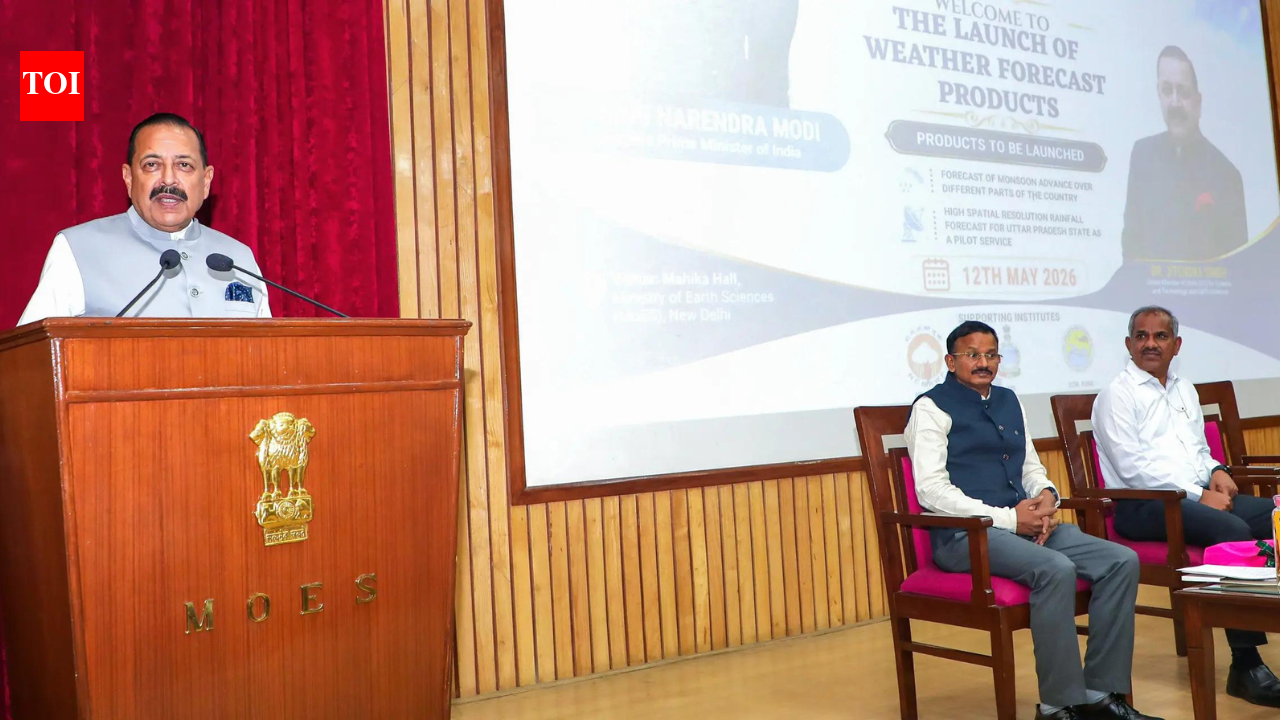

New Delhi: India Meteorological Department The International Institute for Management Development (IMD) in Lausanne on Tuesday launched two new services, including an artificial intelligence-based advance monsoon forecasting system that will provide seasonal rainfall progress and “local weather information” four weeks in advance to support farmers in 16 states and more than 3,000 divisions.On the other hand, the second product involves high-resolution spatial rainfall forecast for Uttar Pradesh as a pilot service. It demonstrates the ability to use a dense observation network and artificial intelligence technology to generate operational rainfall forecasts up to 10 days in advance with a resolution of 1 km. As the observation infrastructure continues to develop, similar services will gradually be expanded to other parts of the country.The pilot system uses advanced artificial intelligence-driven downscaling technology and integrates data from automated rain gauges, automated weather stations, Doppler weather radar and satellite rainfall data sets.These hyper-localized forecast messages will be relayed through displays installed at wet markets and other markets, besides using different modes such as mobile apps, SMS alerts, WhatsApp, Kisan portal, television and other digital platforms. Members of rural self-help groups will also be provided with the information.Launching the two forecast products, Union Earth Sciences Minister Jitendra Singh said the newly launched systems mark a major shift from traditional weather forecasts to impact and decision support-based forecasts, capable of providing “precise, site-specific and actionable information” to farmers, managers, disaster managers and citizens.The system has been jointly developed by IMD, Indian Institute of Tropical Meteorology (IITM), Pune, and National Center for Medium Range Weather Forecasts (NCMRWF).Singh said the initiative would be particularly useful for the agriculture, water resources, renewable energy, urban planning, disaster management and infrastructure sectors. He noted that farmers will now be able to make more informed decisions about sowing, irrigation, crop protection and harvest planning with greater local precision. M Ravichandran, Secretary, Department of Earth Sciences, said the newly launched product is a stakeholder-driven forecasting system developed by combining numerical weather prediction models and data-driven methods based on artificial intelligence. He said the systems were developed to meet the growing demand for “highly localized and high-resolution weather forecasts” in agriculture and other sectors.