
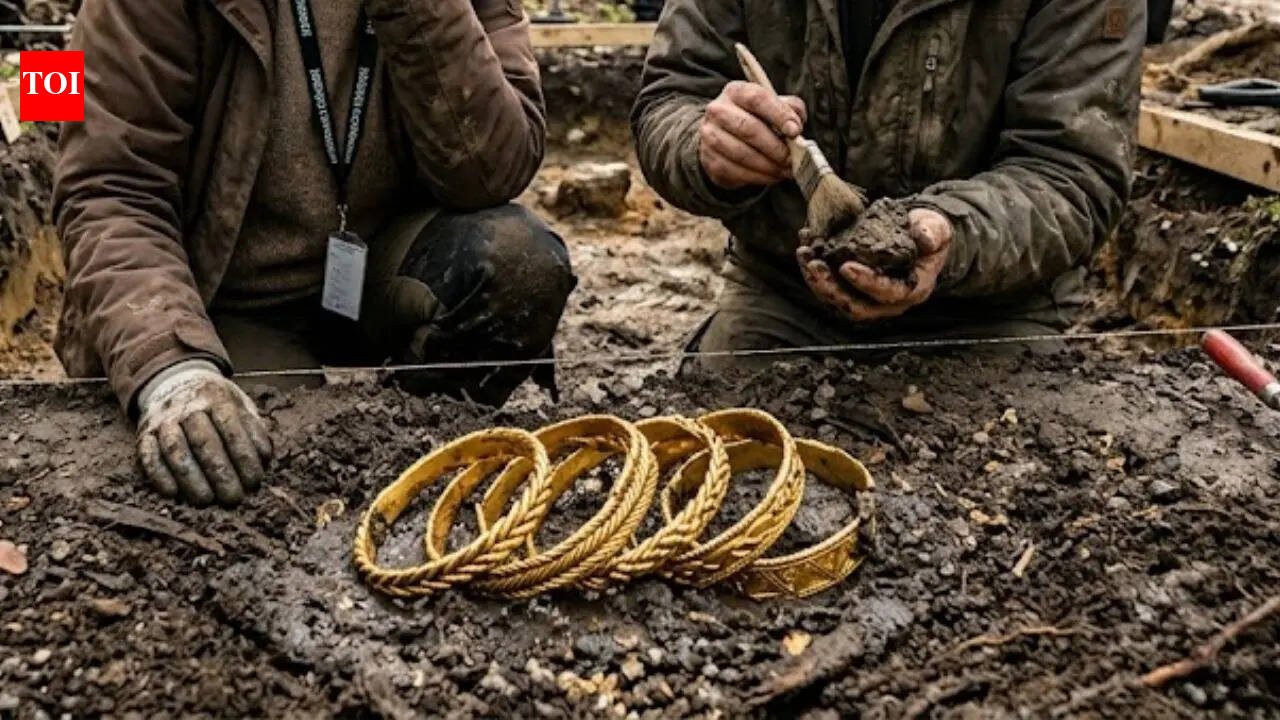
In Denmark, archaeologists were surprised when they discovered a large amount of Viking Age gold in the forests of Himerland. The treasure includes six solid gold armbands weighing 762.5 grams; as the report notes, this is the third largest discovery of this era in Danish history Museum of Northern Jutland. The treasures date back to the 10th century and were partially exposed to the soil by a resident on a forest path rather than in a cemetery. This could mean it was placed there intentionally or hidden during political unification. Now declared a national property, the “Roald’s Treasure” provides a rare, tangible link to the high-status craftsmanship and symbolic wealth of the Viking nobility.
Unique Viking Age gold armband discovered in Denmark
In the forest of Himeran, archaeologists discovered a batch of 6 elite gold bracelets made entirely of pure gold, with a total weight of 762.5 grams. These treasures date back to the late 900s, possibly to the time of Harald Bluetooth. Torben Sarauw, cultural heritage manager and archaeologist at the Museum of North Jutland, noted how similar the rings are to each other. He noted that they may have been made into matching sets as a status symbol for wealthy Vikings. Such riches are rarely found in a single archaeological discovery.
Identified as Denmark’s third largest Viking gold treasure
According to a report published by the Museum of North Jutland, the find ranks as Denmark’s third largest Viking Age gold treasure, mainly due to its weight and purity. Pure gold treasures like this are extremely rare in Scandinavia, where silver is more common. The sheer size of the find suggests its ownership belongs to someone very powerful or influential. As a result, archaeologists now have important new insights into how wealth was distributed in northern Jutland at the end of the 10th century.
Why is gold buried alone?
Museum archaeologists used metal detectors to discover the rings on a path in Roaldskov Forest. Their close proximity to each other suggests that someone buried them at the same time. There are no signs of any tombs or settlements nearby, so experts believe the treasures may have been dedicated to the gods or hidden by an important figure during troubled times.
How Denmark protects its ancient treasures
After their discovery, they quickly reported the find to the museum and classified it as a Danefæ (treasure). This Danish law keeps important cultural objects in public hands. The rings were eventually deposited in the National Museum of Denmark, where experts will preserve them and study their metallic properties. By doing so, they ensured that the 1,000-year-old gold was processed under climate-controlled conditions. Experts also plan to examine how the rings were made to find out if they were made by local craftsmen or if the gold came from elsewhere.