
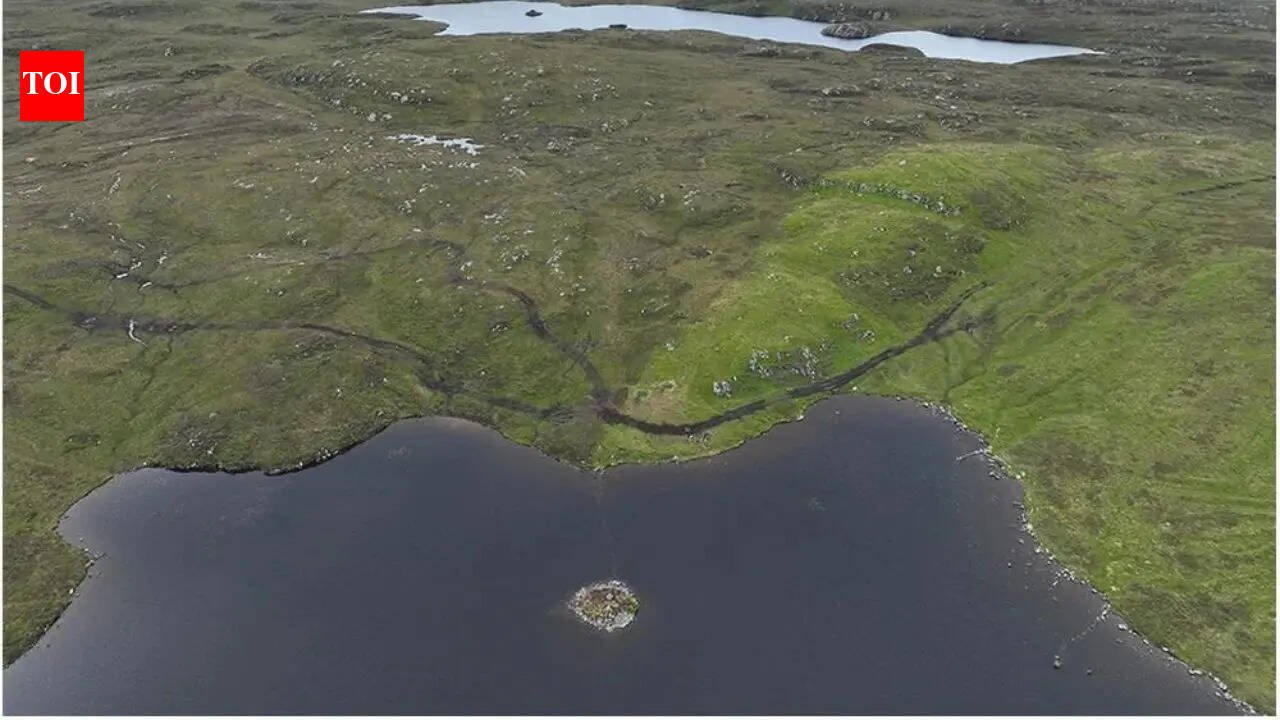

A historic building deep in Loch Borgastail provides information about human existence more than 5,000 years ago. It now appears that this building is just a stone island, formerly a wooden structure carefully built by Neolithic people. The age of this ancient structure makes it older than other famous landmarks such as Stonehenge. This structure challenges traditional views of early social engineering techniques and settlements.From the outside, there is nothing special about the structure. Yet beneath its surface lies evidence of the meticulousness of its construction, its diverse uses throughout history, and its transformation throughout prehistory. Archaeologists say the structure is one of the best examples of ancient humans’ ability to shape their environment.
Scientists discover a lost Scottish island built by humans more than 5,000 years ago
This particular site belongs to a type called a “crannog,” which can be described as a man-made island in a lake. Crannog’s past is primarily associated with the Iron Age and subsequent periods. However, recent discoveries suggest that there may have been some cracks that appeared in earlier times.According to research conducted by experts from the Universities of Southampton and Reading, this particular crannog was built around 3800 to 3300 BC. This means that its construction dates back to the Neolithic Age, before Stonehenge was built.Preliminary analysis shows that Crannog originally consisted of a circular wooden platform about 23 meters in diameter. Its construction involved layers of timber, shrubbery, and stone that anchored the island’s foundations. Later, the island was expanded and improved. Evidence of Bronze Age and Iron Age architecture has been discovered.
Pottery fragments reveal Neolithic activity at the lake
Archaeological surveys have uncovered numerous Neolithic pottery fragments around the site. Some of these containers contained traces of food residue, suggestive of cooking or food preparation activities.This detail changes the way the website is interpreted. It may not be purely symbolic or defensive. Instead, it may be a gathering place for people to meet, share meals, and conduct public activities. Experts say it could have practical and social importance.The idea of people building and using timber islands in the middle of a lake feels unusual today. In the Neolithic world, however, such spaces may have given a sense of separation from everyday terrestrial life. Water boundaries often had meaning in ancient cultures, possibly marking transitions between different social or ritual spaces.Still, much of it remains speculative. The evidence provides clues but not complete answers.
How scientists discovered the hidden route to Clenog
One of the most interesting finds is an underground stone dike connecting the island to the mainland. These suggest that there may have been some easier, possibly even manageable, access to the island initially.During thousands of years of fluctuating water levels, parts of the building must have been submerged, dividing the previously continuous landscape.Surveying such landscapes presents its own challenges, one of which stems from the fact that the area between dryland and deep water is inaccessible to traditional land-based surveys, and underwater methods are not efficient enough.To solve this problem, scientists combined underwater photography, drone photogrammetry and GPS surveys to compensate for the shortcomings of individual technologies and produce an accurate 3D reconstruction of the area, including both land and underwater parts.