
NEW DELHI: India’s school education system has solved most of the challenges of “getting kids into school” but is grappling with a trickier problem – keeping them there long enough to complete secondary and high school education.A new report by Niti Aayog shows that pressure points become more pronounced at higher levels of schooling – the gross enrollment ratio (GER) fell from 90.9 per cent in primary school to 58.4 per cent in high school, while the dropout rate at the secondary level rose sharply from 0.3 per cent in primary school to 11.5 per cent.The report, “India’s School Education System: Temporal Analysis and Policy Roadmap for Quality Improvement,” paints a picture of a large but uneven system of 1.471 million schools, 2.469 million students and about 101,000 teachers, with the most serious cracks now appearing after the primary level.
NITI report: Secondary school dropout rate jumps to 11.5%
It said today’s system is “strongest on basic access but weakest on continuity, inclusion and depth of learning”.The figures clearly illustrate the challenge. The GER in India is 90.9% at the primary level and 90.3% at the upper primary level, but drops sharply to 78.7% at the secondary level and further drops to 58.4% at the high school level.Transfer rates steadily decline as students advance through the system. While 92.2% of students progressed from primary school to primary school, the proportion between upper primary school and secondary school dropped to 86.6%, and between secondary school and high school to 75.1%. The second phase has become the biggest pressure point. The national primary school dropout rate is only 0.3%, and the dropout rate in the upper grades of primary school is 3.5%, but the secondary school dropout rate jumps to 11.5%.
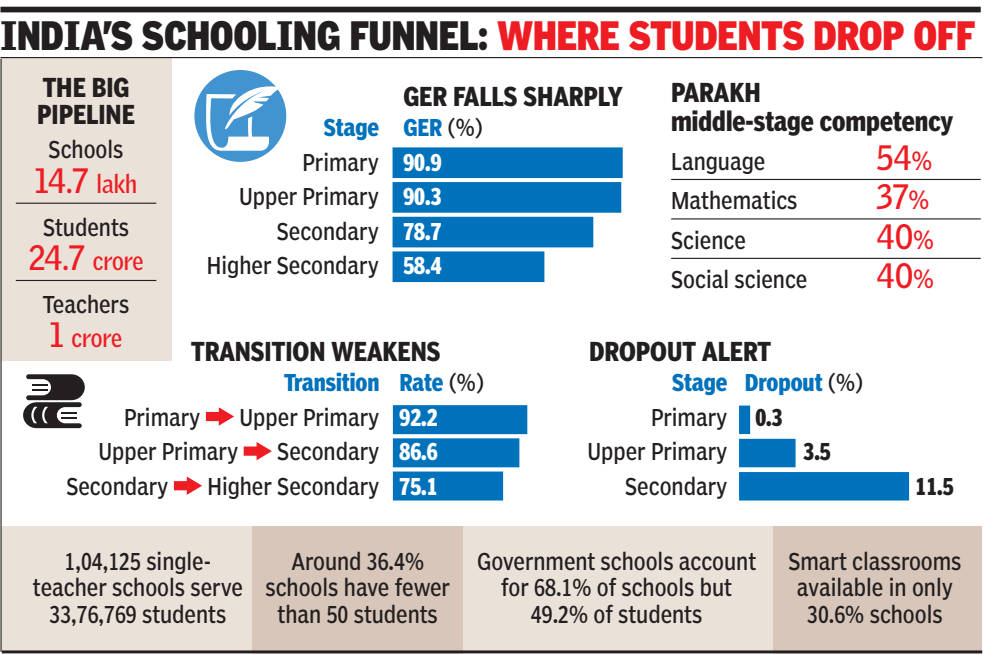
“While near universality has been achieved at the primary level, enrollment at the upper secondary level… offers important opportunities to further expand participation,” the report states. “Strengthening transition rates at each stage, especially after the upper primary years… can Helps ensure smoother progression to school and continued participation in schooling. “The next phase of reforms can no longer focus solely on expanding enrollment or infrastructure, but must address “fragmented school structures, inadequate foundational learning, inclusion inequalities, gaps in teacher and leadership ecosystems, infrastructure disparities and governance weaknesses,” the report said.Structural inefficiencies remain severe. More than one-third of schools have fewer than 50 students, while more than 104,000 schools continue to operate as single-teacher institutions, serving nearly 3.4 million students. At the same time, the report documents significant progress in infrastructure development over the past decade. Currently, 91.9% of schools across the country are equipped with functional electricity, 94% with girls’ toilets, 64.7% with computers, 63.5% with internet connectivity and 30.6% with smart classrooms.