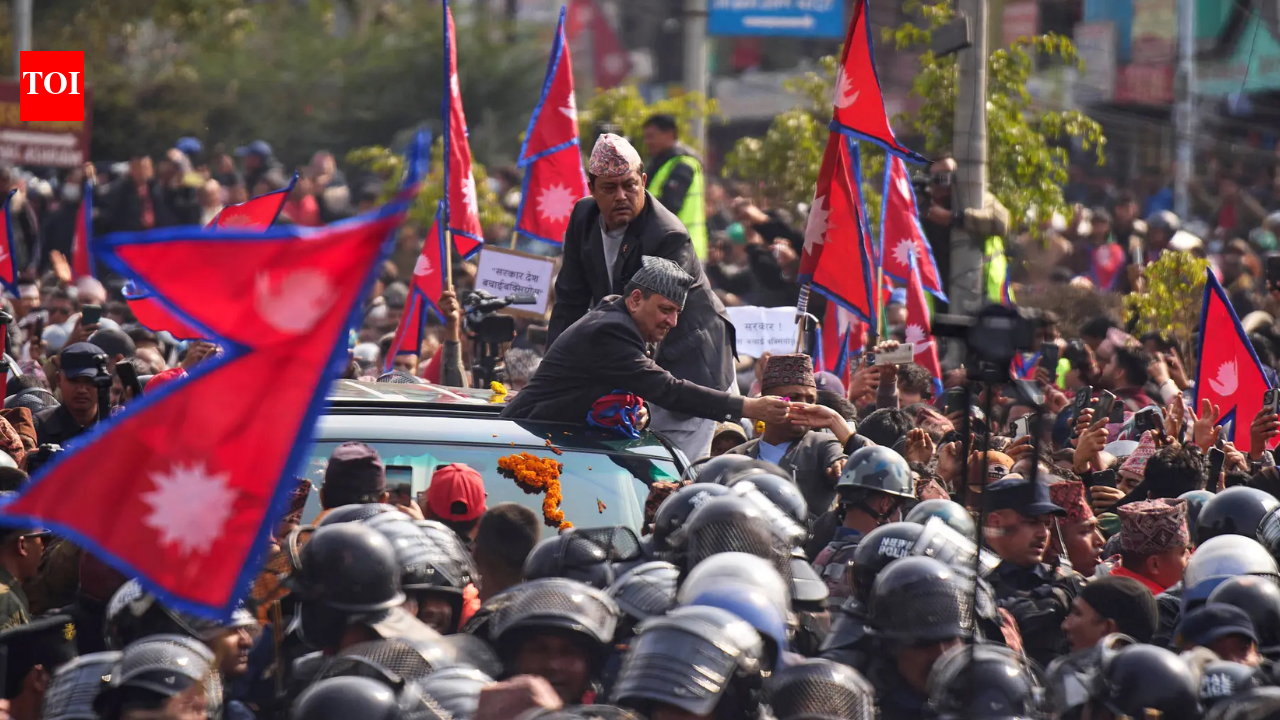

Thousands of supporters of Nepal’s former king gathered outside Kathmandu’s Tribhuvan International Airport on Friday, demanding the restoration of the monarchy that was deposed nearly two decades ago.As hundreds of police in riot gear tried to control supporters at the airport’s main gate, Gyanendra Shah waved to cheering crowds from the sunroof of her car. The former king had just returned from a trip to eastern Nepal.“Bring back the king. We love our king more than ourselves. Restore the constitutional monarchy,” the crowd chanted.More supporters lined the route from the airport to his private residence. The rally remained peaceful and no arrests were reported. As Gyanendra returned home from a three-month holiday in eastern Nepal, pro-monarchy demonstrators chanted “King, come save the country,” laid flowers and waved national flags.“We must restore the monarchy because the king can be a caring guardian for all Nepalese people, which many corrupt political leaders fail to do,” said Sanatan Prasad Regmi, 55, a Gyanendra supporter. “We don’t need a republic.”
Protest despite restrictions
The rally took place despite a prohibitory order issued by the Kathmandu District Administration Office banning gatherings of more than five people in the airport area and surrounding areas.Security around the airport is tight to prevent the situation from escalating.Cadres of the pro-monarchy Rastriya Prajatantra Party, led by senior leader Kamal Thapa, were present. They were joined by loyalist groups led by Navaraj Subedi and medical professional Durga Prasai, who had been gathering at the airport area since Friday morning.
Why monarchy issues are resurfacing again
Nepal abolished the monarchy in 2008 after massive street protests in 2006 forced Gyanendra to give up his dictatorship. Parliament later voted to formally end the monarchy, and he left the palace to live a civilian life in Kathmandu.However, pro-monarchy demonstrations re-emerged last year amid economic difficulties and ongoing political instability. Nepal has gone through 14 changes of government in the past 18 years, a pattern that has unsettled investors and slowed economic growth.Many Nepalis have expressed disillusionment with the republican system, accusing it of failing to deliver on its promises of development and job creation.
Political context and upcoming elections
Gen Z youth activists led protests on September 8, triggered by growing dissatisfaction over corruption, lack of accountability and perceived failures of political elites after Nepal’s government banned social media.The unrest led to the resignation of Prime Minister Sharma Oli. Nepal’s first female chief justice Sushila Karki was sworn in as interim prime minister.Karki, 73, will hold the post until the first week of March, when elections will be held to select a new chief executive. The movement, dubbed the Gen Z Revolution, left 74 people dead when police used lethal force to quell protests against the KP government Sharma Oli is currently in hiding.The royalist support also comes ahead of parliamentary elections scheduled for March 5. A total of 65 political parties are running for 275 seats in parliament. Nearly 19 million of Nepal’s 30 million people are eligible to vote, including nearly 1 million new voters, mostly young people, after recent protests.Pro-Gyanendra groups secured about 5% of the seats in the last election and want to increase their representation.At a press conference in Kathmandu on Thursday, Durga Prasai said they wanted to restore the monarchy before the March 5 general election. He claimed that elections cannot be held without addressing the agenda of relocating a Hindu monarch in the country.Despite apparent support from royalist groups, Gyanendra’s chances of an immediate return to power are limited as parties opposed to a return to the monarchy still enjoy wider political support.