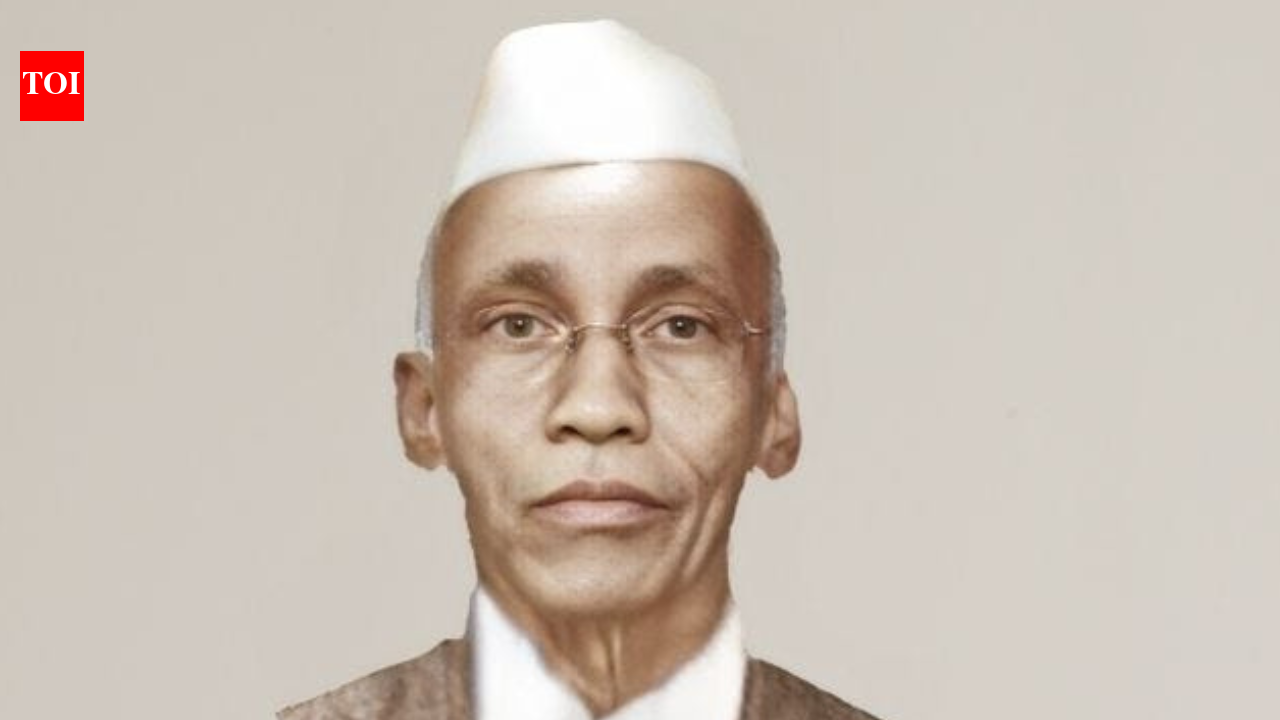
Meet Dattatreya Ramchandra Kaprekar: The Indian mathematician discovered a ‘ghost number’ that always returns to itself |

In a humble classroom in Devlali, near Nashik, a teacher quietly discovered one of the most interesting patterns in mathematics. Born in 1905, Dattatreya Ramchandra Kaprekar did not belong to the elite academic circles, but his fascination with numbers led him to discover an extraordinary constant: 6174. What’s remarkable about this figure is its behavior. Applying a simple number-based process to almost any four-digit number, where not all numbers are the same, it inevitably converges to 6174, looping infinitely once it is reached. Although initially underrecognized in formal academic settings, his work later gained international attention and continues to influence mathematics education and computer science.
How Dattatreya Ramchandra Kaprekar was discovered Kapreca’s constant
Capreca is fascinated by simple numerical patterns. Instead of working on complex formulas, he experimented with everyday numbers to see how they performed when rearranged. While playing with four-digit numbers, he noticed a striking pattern. No matter which number he started with, the same results kept coming.Here’s how it works in a simple way that anyone can try:Take any four digit number where not all digits are the same. Rearrange its numbers so that the number is as large as possible and the number is as small as possible. Subtract a smaller number from a larger number. Then repeat the same steps with the new number you got.After doing this a few times, up to seven iterations, something surprising will happen. The result always becomes 6174.Once 6174 is reached, the process stops changing. Even if you repeat these steps again, you will still get 6174. Simply put, the number is stuck there.Mathematicians call this behavior fixed point, which means that the process always stabilizes at the same number. This is why 6174 is often called the “ghost number” because it keeps showing up no matter where you start.Capreca didn’t use advanced tools or computers to discover this. He discovered this by patiently experimenting with numbers and observing patterns, showing how powerful simple curiosity can be.
Mathematicians outside formal academia
Unlike many recognized mathematicians of his generation, Dattatreya Ramchandra Kaprekar worked primarily as a teacher and conducted research independently. He does not have a PhD and is not affiliated with a major research institution. His focus on patterns in numbers rather than formal theoretical frameworks meant that his work was sometimes viewed as recreational. Although his ideas were original and insightful, this limited the recognition he received in his early years.Capreca’s research began to attract wider attention in the mid-1970s, when Martin Gardner published his findings in Scientific American. Gardner’s columns were widely read and helped introduce Capreka’s findings to international readers. After this exposure, Capreka’s constant became popular in the mathematical community, appearing in computer science puzzles, textbooks, and discussions.
Contributed over 6174
Capreca’s curiosity goes beyond a single discovery. He identified what are now called Capreca numbers, such as 45, in which the square of a number can be divided into parts that add up to the original number. He also explores self-numbers that cannot be generated through certain number-based operations. Through these studies, he developed a body of work centered on numerical transformations and patterns that is closely integrated with modern concepts of algorithmic thinking and iterative computation.
Why Capreca’s constant is important today
Capreka’s constant is widely used as a teaching tool because it shows how simple rules can lead to predictable results. It illustrates the concepts of iteration, where the step-by-step repetition of a process, and convergence, where repeated steps produce stable results. These ideas are fundamental to computer science, especially in understanding loops, recursion, and iterative algorithms.Although Dattatreya Ramchandra Kaprekar was not widely recognized for most of his life, his work has endured and grown in importance over time. Today, his findings are incorporated into textbooks, programming exercises, and mathematical explorations around the world. The number 6174 has become a well-known constant and his methods are used to introduce students to logic and computational thinking.
a number that keeps coming back
The 6174’s enduring appeal lies in its simplicity. Simple numerical procedures produce consistent and unavoidable results, revealing results that initially appear random. Each time the Kaprekar routine is performed, it recreates insights first observed by school teachers working outside major academic institutions. His work continues to demonstrate that meaningful discoveries can emerge from curiosity, persistence, and deep engagement with simple ideas.