

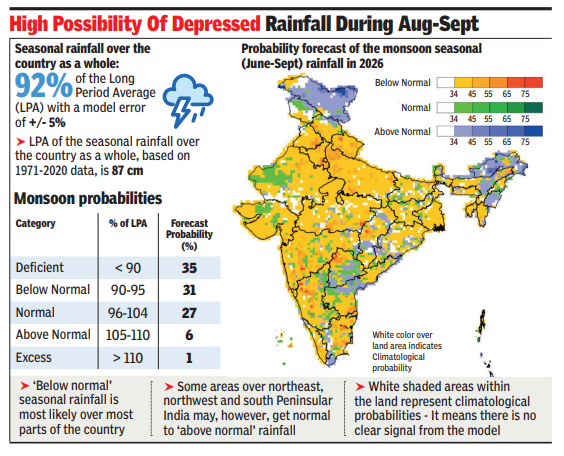
NEW DELHI: The IMD on Monday predicted that India’s southwest monsoon (June-September) will be “below normal” due to the increasing risk of El Niño, which is associated with reduced summer rainfall in India. “Quantitatively, seasonal rainfall across the country is likely to be 92 per cent of the long-term average (LPA) with a model error of +/- 5 per cent,” IMD chief Mrutyunjay Mohapatra said while releasing the first phase of the long-term monsoon forecast. Based on data from 1971-2020, the LPA of seasonal rainfall in India is 87 cm. Rainfall between 90-95% of the LPA is considered “below normal.” The IMD’s forecast gives a 31% chance of “below normal” rainfall and a 35% chance of deficient rainfall (lower than the LPA’s 90%) – a clear indication of a higher likelihood of a significantly below normal monsoon in the country.
Below normal rainfall may affect irrigation, kharif, rabi areas
While the Meteorological Department will issue more specific and updated forecasts for the spatial distribution of rainfall during the season (June to September) in the last week of May, the “Probabilistic Forecast” map it has released clearly shows “below normal” rainfall in the country’s “monsoon core” – including large parts of central and western India, where agricultural production relies heavily on rainfall.
This scenario is most likely to affect irrigation, drinking water supplies, reservoir capacity and hydropower potential in arid and semi-arid areas, at a time when the country is already facing high input (diesel and fertilizer) costs for agricultural operations and overall high energy costs due to conflicts in West Asia. Reduced rainfall has adversely affected not only the area of kharif crops sown in summer but also the area of rabi crops sown in winter due to reduced soil moisture content and reduced irrigation water in reservoirs. Although the country has taken several measures over the years to insulate its agricultural sector from the effects of drought, the situation is likely to affect overall food production. The IMD said rainfall is likely to decrease in the second half of the monsoon season (August-September) due to the possible development of El Niño – a climate condition associated with a warming of the ocean surface in the central and eastern tropical Pacific. The silver lining is that conditions in the Indian Ocean, known as the Indian Ocean Dipole (IOD), may improve around August. “Positive IOD brings more rainfall. So, we expect this to offset the impact of El Niño in the second half of the monsoon season,” Mohapatra said. Neutral IOD conditions currently exist over the Indian Ocean, and the latest climate model projections indicate that positive IOD conditions may occur at the end of the southwest monsoon season, but the problem is that IOD is often unpredictable.