
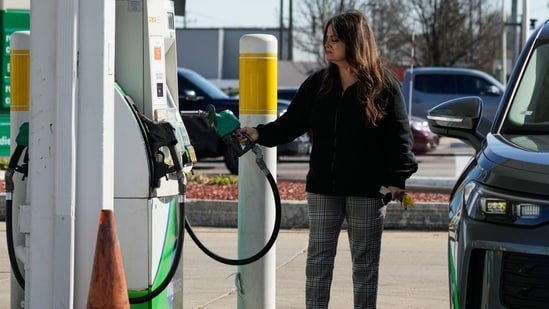
Junelle Lewis was looking for relief from the pressure from the war with Iran that has driven up gas prices in the Seattle area, when an app on her phone gave her the answer: the Tulalip reservation north of the city, nearly a half-hour from her home.

She didn’t hesitate.
“I drive here specifically just to get gas,” Lewis said this week as she filled up her Chevrolet Suburban at a Tulalip market, where the price was $4.84 per gallon (3.8 liters), about 75 cents cheaper than prices near her hometown. “Gas is ridiculous. But honestly, I’ve found this gas station to be cheaper than a lot of gas stations here over the years. Probably the cheapest.”
Lewis isn’t the only driver to discover that some of the cheapest fuel can be found on Native American reservations.
Particularly in California, New Mexico, New York, Oklahoma and Washington state—where there are dozens of tribal-owned gas stations, some located in busy travel corridors—tribes exempt from state gas taxes sell for much lower prices than nearby competing gas stations.
Gas prices drive bargain hunting
Apps like Gas Buddy make finding the cheapest gas easier than ever.
Since the war with Iran began on Feb. 28, gasoline prices nationwide have risen more than $1 to an average of $4.15 a gallon, according to AAA.
Prices have been heading higher, topping $5 in the summer of 2022, but economists believe prices will continue to rise as geopolitical tensions persist, fueling inflation in the coming weeks.
However, you can find discounts at many of the nearly 500 tribal convenience stores with gas stations across the United States
Fifty Five is located in California. At the Chukchansi Crossing gas station and tourist center between Fresno and Yosemite National Park, gas costs $5.09, 60 cents cheaper than at nearby gas stations.
New Mexico resident Jamie Cross usually saves money on the Mescalero Apache Reservation, where gas prices were as low as $3.79 this week.
“I hope we don’t go higher,” Cross said Thursday.
In eastern New York state, on Catauragus Indian Territory between Buffalo and Erie, Pa., the cheapest gas at six stations was about $3.65, 50 cents cheaper than in nearby towns.
Tribal lands find way to evade gas taxes
So how do tribes do it? Two words: tax-free.
Generally, tribes must pay federal fuel taxes, which are 18.4 cents per gallon on gasoline and 24.3 cents per gallon on diesel, and pass that cost on to drivers. State fuel taxes are another story.
For more than a century, U.S. courts have held that states do not have the right to tax Native Americans on their lands, said Dan Lewerenz, an assistant law professor at the University of North Dakota who specializes in Native American law.
“The Supreme Court has consistently upheld this view, which is one of the most enduring principles of Indian federal law,” Leverenz said.
Federally recognized Native American tribes are located in 35 states, and state gas taxes range from 9 cents per gallon in Alaska to 71 cents per gallon in California.
From there, things get complicated based on where fuel is taxed (for example, at a fuel terminal, or when a distributor buys or sells fuel) and various agreements between states and tribes.
The court ruling comes into play. In 2005, the U.S. Supreme Court ruled that off-reservation dealers in Kansas could collect state taxes on sales of on-reservation fuel to tribes. But in 2019, the Supreme Court ruled that an 1855 treaty between the United States and the Yakama Nation, which ensures tribal members the freedom to travel on roads carrying goods, prohibits the imposition of state gas taxes on tribal lands in Washington state.
“It’s a little different from the principle of no taxation by Indians within Indian territory, because this particular treaty also reserves certain off-reservation rights for Indians,” Leverenz said.
Gas is just a way for stores to make money
Convenience store gas sales are not as profitable as bringing people in from the gas station.
Selling snacks can increase profits. But tribal businesses are increasingly delivering groceries in “food deserts” far from grocery stores.
“Sometimes these gas stations and convenience stores are the closest and best place to buy affordable food or household supplies,” said Matthew Klas of Klas Robinson QED, a consulting firm in Minneapolis.
Klas conducts market research and consulting for tribal businesses and tracks 245 tribes across the country, which as of 2025 operate 496 convenience stores with gas stations.
Oklahoma, California, Washington, Arizona, New Mexico, Wisconsin, Michigan and New York have the most. Some tribes, including the Choctaw Nation of Oklahoma and the Oneida Indian Nation of New York, have their own chain stores.
Drive-thru smoke shops, car washes and truck stop facilities also bring in revenue. And then there are the casinos: There are 205 tribal-owned gas stations in or near them.
Some tribal casinos are resorts with gas stations. Some tribal gas stations are a type of casino called “gasinos” with only a handful of gambling machines.
Tribal-owned businesses are a major source of revenue on Native American reservations. On the Tulalip Reservation in the Seattle area, growing gas sales are being reinvested in the community, helping to pay for roads, police, health care, education, housing and other needs, Tanya Burns, CEO of the Tulalip Tribal Confederated Corporation, said in a statement.
“Like any government, we provide critical services to our people,” Burns said.
It’s not just about saving
“It’s terrible,” said Todd Hall of Paden, Oklahoma, who paid about $90 to fill up his trailer at a Citizen Potawatomi Nation gas station about 30 miles (48 kilometers) west of Oklahoma City.
But, he added: “The prices here are cheaper than elsewhere.”
Hall pays $4.57 a gallon for diesel and said prices are more than $5 in many places in the area.
Mark Foster said he saves about $5 a week buying fuel at tribal-owned gas stations. But he said he’s a loyal customer because the tribe is a good community partner.
“I like the way the tribe operates,” he said. “And the price is good.”
At the Tulalip Market north of Seattle, Jared Blankenship’s complaint wasn’t about the price, but about the gas he had to pay.
“Yeah, well, my electric car just died,” Blankenship said. “So this sucks. This is new. Either Costco or find a cheaper place like the rez. So here we are.”