

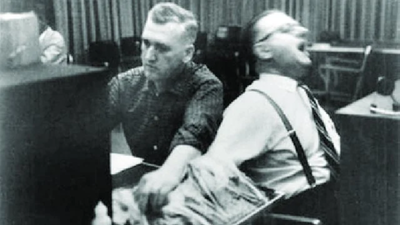
In the early 1960s, a seemingly simple question arose in a Yale University laboratory: How far would an ordinary person go if instructed by an authority figure to harm others? Psychologist Stanley Milgram provided an answer that would become one of the most cited and controversial discoveries in modern psychology.Milgram’s obedience experiments, conducted between 1961 and 1962, did not begin as abstract inquiries. They were shaped by the aftermath of the Holocaust and, more specifically, by the trial of Adolf Eichmann, who defended his role in organizing the logistics of the mass deportation of Jews to ghettos and extermination camps, a central part of the Nazis’ program of systematic mass murder, claiming that he was “merely following orders.”Stanley Milgram asked the question directly in his 1974 book Obedience to Authority: “Were Eichmann and his millions of co-conspirators in the Holocaust simply following orders? Can we all call them accomplices? “
How the experiment is designed
Milgram recruited participants through newspaper ads, presenting the study as a study on learning and memory. In the most widely cited version, 40 men participated, each paying $4.50. Participants were assigned the role of “teacher.” Another person was introduced as a participant but was actually an actor working with the researcher, playing the role of a “learner.” Learners were placed in a separate room and connected to what appeared to be an electric shock device. The teacher sat in front of a shock generator with voltages ranging from 15 volts to 450 volts in 15 volt increments. The switches are labeled in escalating terms: “Mild Shock,” “Moderate Shock,” and “Danger: Severe Shock,” with the final switch simply labeled “XXX.” The task is structured but repetitive. The teacher reads out the word pairs and tests the learner’s memory. Each wrong answer requires an electric shock, and the voltage increases each time. The shock wasn’t real. Participants did not know this. As the course progresses, learner responses are scripted. At lower levels, he showed mild discomfort. As the voltage increased, his reactions became more urgent, he complained of a heart attack, demanded to be released, and began banging against walls at 300 volts. After saying that, he fell silent. The experimenter instructed that silence should be considered an incorrect answer. When participants hesitated, they received a series of standardized prompts: “Please continue.” “The experiment requires you to continue.” “It is absolutely essential that you continue.” “You have no choice, you have to carry on.”
What Milgram reported
In the most famous version of the experiment, the results were shocking: 65% of the participants (26 out of 40) continued to use the maximum voltage of 450 volts. Many showed visible distress. Some protested, some laughed nervously, others questioned the procedure. Many people ask if they should stop. But with guidance, most continued. Milgram concluded that people are highly sensitive to authority, even when obedience conflicts with their personal values. He believed that it was situational factors that influenced behavior, not just individual personality. Some of these factors are consistent across versions. The physical presence of an authority figure increases compliance. Partnering with Yale brings credibility and trust. The gradual increase in voltage makes each step feel gradual rather than extreme. Participants also seemed to shift responsibility to the experimenter, believing they were following instructions rather than making independent decisions. When these conditions change, obedience changes. Compliance decreases when authority figures are absent or giving instructions remotely. Compliance dropped sharply when other participants refused to continue, and in one case 36 of 40 participants stopped early.
What the experiment showed, and what subsequent research discovered
Milgram’s research showed that obedience is not just a matter of personality but also a matter of environment. In some cases, individuals may comply with instructions that they would otherwise refuse. Later research made the situation more complicated. Research and analysis show that obedience depends not only on authority but also on identification, the extent to which participants identify with the authority figure’s goals and identify with the authority figure. When people believe that authority is legitimate and consistent with their own values, they are more likely to follow instructions.
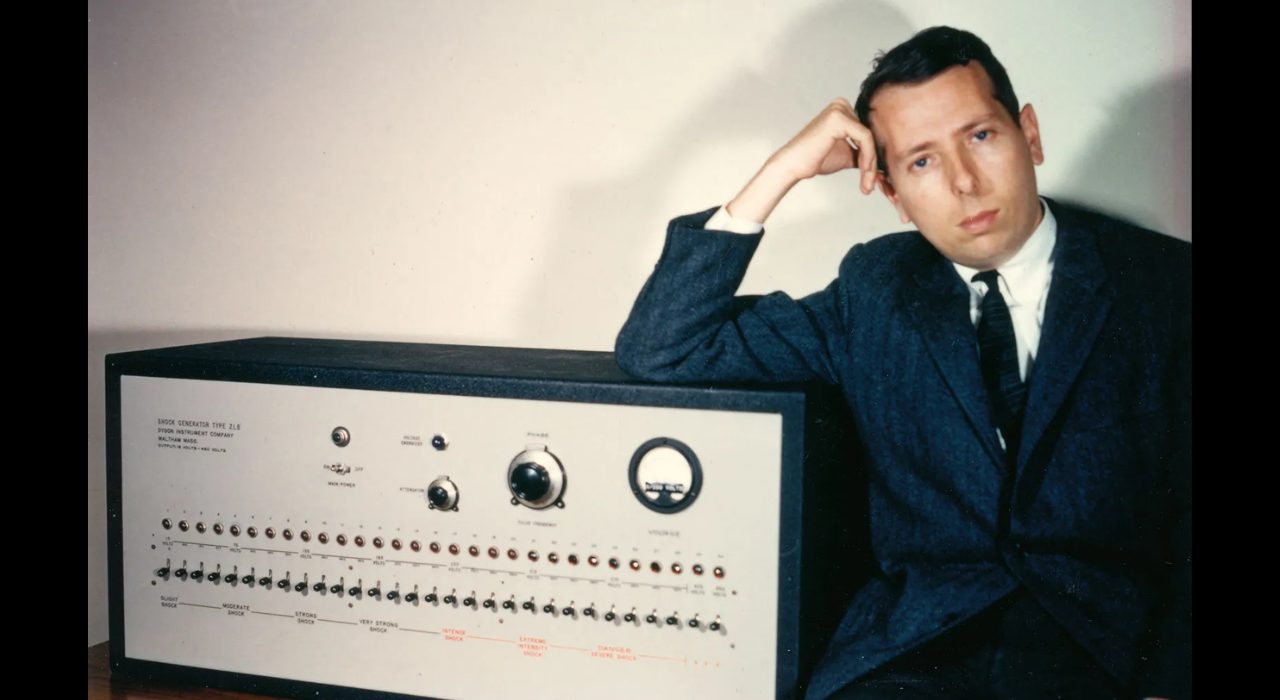
Stanley Milgram American social psychologist Stanley Milgram and the “shock generator” used in famous experiments at Yale University in the 1960s/Photo: Encyclopedia Britannica
Additional analyzes found multiple variables that influence compliance, including proximity to the victim, the legitimacy of the authority, and the presence of dissenting colleagues. These findings suggest that obedience is not automatic or consistent but is determined by specific social conditions.
Ethical issues and criticism
From the outset, these experiments raised serious ethical questions. Participants were deceived about the nature of the study and led to believe they were causing real harm. Many people experience severe psychological distress, including anxiety, stress, and guilt. The experimenter’s insistence, especially the instruction “You have no choice; you must continue,” has been criticized as undermining the participant’s right to withdraw. Participants were then debriefed and the true nature of the experiment explained, Milgram said. However, subsequent investigations raised questions about the consistency and thoroughness of this approach.Australian researcher Gina Perry examined archived recordings and documents to write “Behind the Shock Machine: The Untold Story of the Infamous Milgram Psychology Experiment” after retracing Milgram’s footsteps and interviewing participants decades later. She believes the reality of the experiment is more complex than published reports suggest, noting that what appears to be obedience may also resemble stress: “When you listen to these recordings, the slavish obedience to authority we associate with Milgram’s experiments sounds more like bullying and coercion,” Perry suggested in a report. article For Discovery Magazine. Perry’s study also raised questions about debriefing, showing that many participants were not fully aware of the deception, sometimes for months or even years.
Questions about validity and reproducibility
Further criticism focused on how the results were interpreted. A widely quoted figure. 65% of obedience comes from a specific change. In other versions of the experiment, compliance rates were significantly lower, and in some cases, no participants gave the biggest shock. There was also evidence that some participants were skeptical of the setup. Later analysis showed that those who believed the shocks were real were less likely to continue, while those who doubted that the learners were actually harmed were more likely to continue. Replications of the study produced mixed results. Ethical constraints need to be modified, for example, limiting maximum shock levels or screening participants more carefully. Some of these studies found similar compliance patterns, while others suggested that differences in design make direct comparisons difficult. The core problem remains unresolved: The original experiment cannot be fully replicated under modern ethical standards, which limits the ability to verify its findings in the same form.
Why experimentation still matters
Despite its problems, the Milgram experiment still occupies a central place in psychology. It is often taught not only because it purports to demonstrate obedience but also because it reveals the limitations of experimental designs.Part of its impact comes from the simplicity of the setting, a clear, controlled situation that produces results that many find both disturbing and familiar. It provided a way for people to think about authority, responsibility, and moral choices, while also sparking ongoing debate about how the experiment itself was conducted.As Gina Perry notes, this research endures as a lasting narrative rather than a definitive answer. Reflecting on its legacy, she noted: “I think it puts social psychology in a difficult position… It’s an iconic experiment. I think it does beg the question of why we continue to cite and believe Milgram’s results. I think the reason Milgram’s experiment is still so famous today is because in a way it’s like a powerful allegory.” It’s so well known and often quoted that it takes on a life of its own. …This experiment and this story about ourselves did something for us 50 years later. “