World’s oldest computer revealed: YouTuber’s data gives scientists new insights into 2,000 years of computing history |

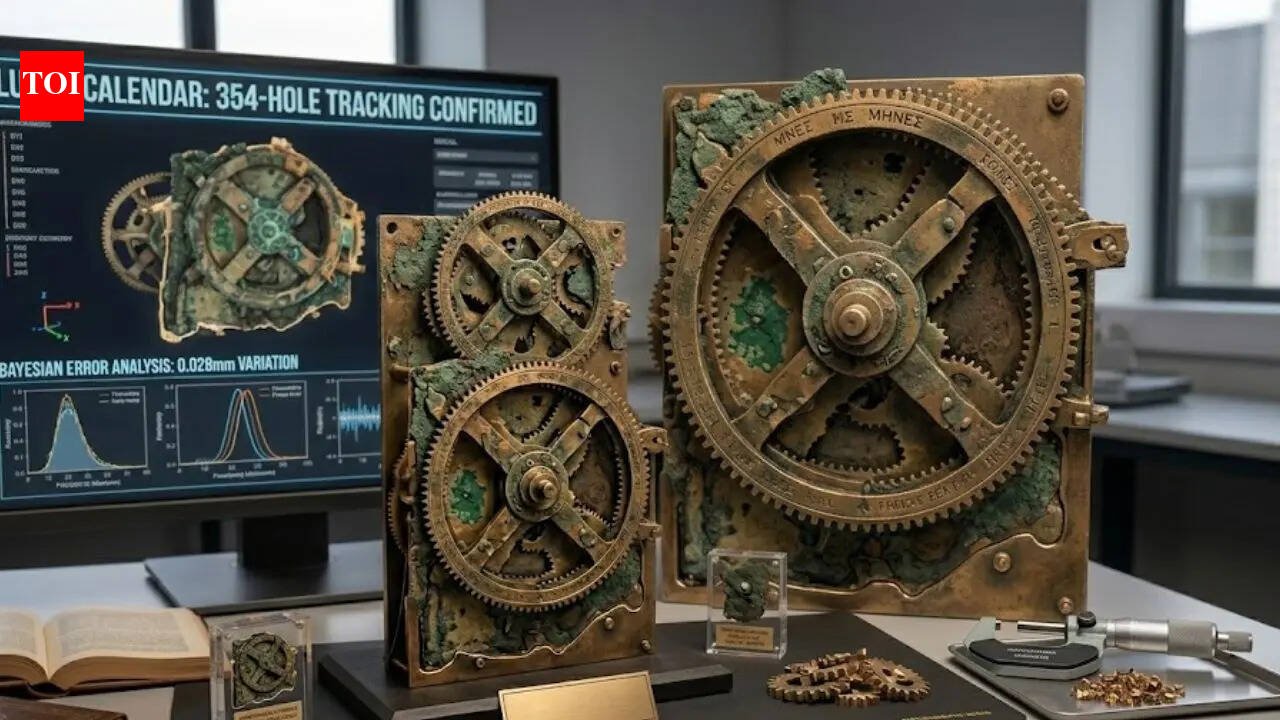
Since its discovery in a shipwreck off the coast of Greece in 1901, the Antikythera mechanism has been described as the world’s first analog computer, but until now, we didn’t know exactly how its internals were configured. The Anticythera mechanism, a corroded copper stamp found in a Roman shipwreck in 1901, has been called the world’s first analog machine ever since its discovery. However, its internal kinematics have remained a mystery for the past 2,000 years. Scientists at the University of Glasgow used experimental archeology combined with the discovery of the Antica Tyrrenia mechanism experimentally constructed by Chris Budiselic (Clickspring) to complete one of the first major studies using the new approach. The data are included in a complete analysis using Bayesian statistics (originally developed to search for gravitational waves). The end result of this interdisciplinary study confirms that the device was constructed and calibrated to track the lunar calendar, and it provides a glimpse into how ahead of their time ancient Greek craftsmen were and how advanced they were at the same time in history compared to today’s modern digital computers.
Chris Budiselic helps scientists solve the mystery The world’s oldest computer
According to the University of Glasgow, YouTuber Chris Budiselic, creator of the YouTube channel “Clickspring,” can be credited with pioneering this breakthrough, which stemmed from his years of documenting his attempts to create a true historical replica of the Antikythera Mechanism. This process allowed him to provide researchers Graham Vaughan and Joseph Bailey with important physical data that helped them analyze ancient parts of the mechanism using modern statistical models. His applied experimental archeology provides researchers with baseline data that traditional observational methods have not been able to provide for more than 100 years.
How scientists mapped rings from 2,000 years ago
Using Bayesian analysis, the Glasgow researchers determined that the device’s date ring had 354 or 355 holes, as written in Watch Journal. This method is a statistical analysis method commonly used to analyze space gravitational wave signals by removing background noise. Using this method, combined with data provided by the Clickspring replica, they found that the calendar was constructed according to the Greek lunar calendar, with 354 days (followed by a leap day). Therefore, it is not a representation of the 365 days of the solar calendar.
Why computing technology from 2000 years ago was ahead of its time
According to the study, the holes in the ring are arranged with a radius of approximately 77.1 millimeters and a radial variation of only 0.028 millimeters, suggesting that the ancient Greeks were likely able to apply very complex segmentation mechanical or geometric techniques. These results demonstrate that technological advancement is much more advanced than once thought and that mechanical computing is much more advanced than was imagined 2,000 years ago.
How the Ancient Greeks Used This Device to Mechanically Encode Bronze
Originally discovered in 1901 off the coast of the Greek island of Antikythera, the device was manufactured around 60-70 BC and is now believed to be the world’s earliest surviving example of analog computing. The Antikythera Mechanism acted as a celestial calculator, mechanically encoding eclipses and the epicyclic motion of the five known planets through carefully calibrated gear geometries.