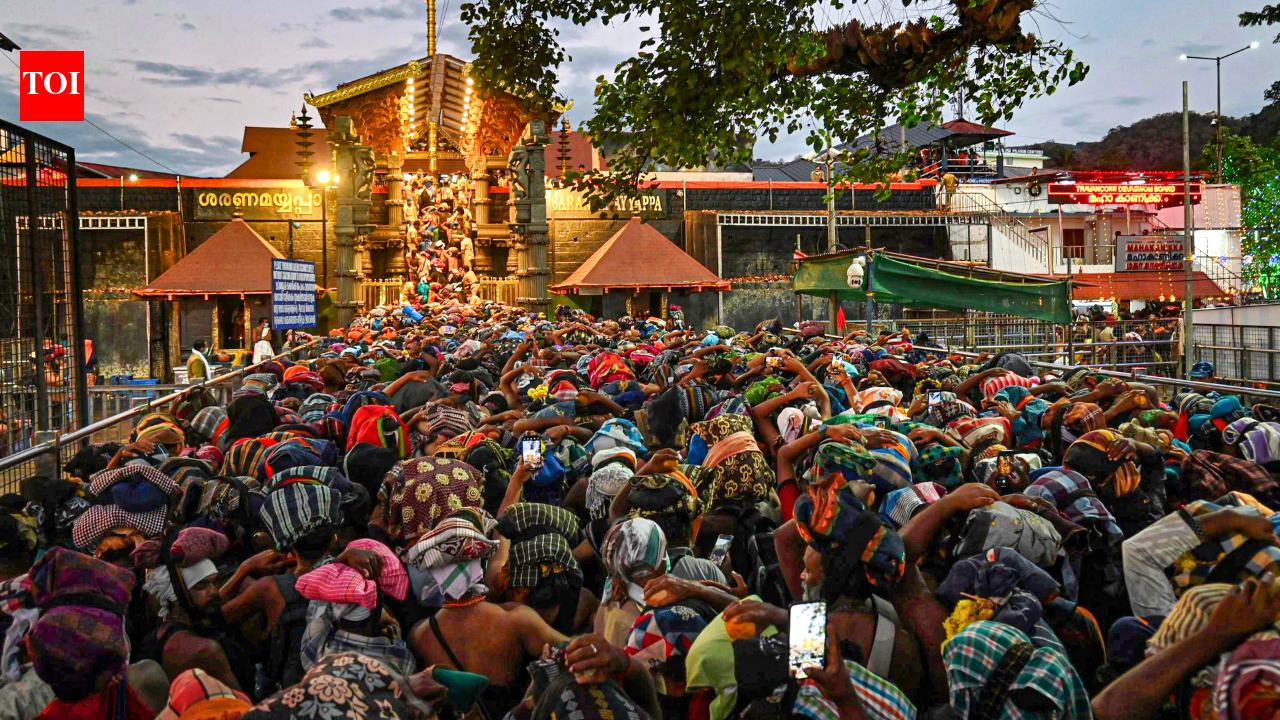
Sabarimala temple case: Center backs restrictions on women’s entry, says 2018 judgment presumed ‘male superiority’

New Delhi: Center on Thursday backed restrictions on entry of menstruating women into Kerala Sabarimala Templeargued before the Supreme Court that the 2018 decision lifting the ban was based on the assumption that men are superior to women.A nine-judge Constitution bench headed by Chief Justice Surya Kant is currently hearing a batch of petitions regarding women’s entry into places of worship and wider religious freedom across faiths.
Appearing before the Centre, Solicitor General Tushar Mehta said religious activities cannot be viewed solely through a gender lens and cited instances where men were also barred from certain temples or asked to follow certain customs.Talking about traditions related to gods, Mehta believes that the customs in Sabarimala are rooted in faith and not discrimination. He mentioned the Kottankulangara Sree Devi temple in Kerala, where men dress up as women during the Chamayavilakku festival, highlighting the diversity of religious practices.“This is not a question of male-centric or female-centric belief. In this case, it happens to be female-centric,” Mehta told the bench, which comprised Justices BV Nagarathna, MM Sundresh, Ahsanuddin Amanullah, Aravind Kumar, Augustine George Masih, Prasanna B Varale, R Mahadevan and Joymalya Bagchi.Additional Solicitor General KM Nataraj argued that “public morals”, rather than “constitutional morals” as explained earlier, should guide the court’s approach.The matter dates back to the Supreme Court’s 2018 ruling, which by a 4-1 majority overturned the Sabarimala Ayyappa temple’s ban on women aged 10 to 50, declaring the practice unconstitutional.In 2019, a subsequent five-judge bench, led by former Chief Justice Ranjan Gogoi, referred the broader issue of gender discrimination in interfaith places of worship to the larger bench, noting that the issues required deeper scrutiny beyond individual cases.
polling
Do you think the Supreme Court’s 2018 decision was fair?
Ongoing hearings are expected to determine how the constitutional principle of equality integrates with the right to practice religion.