
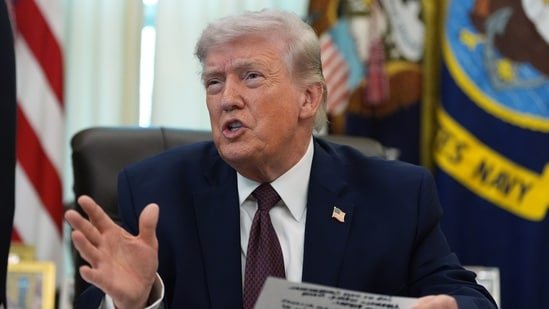
president Donald Trump Never sat on King Cecilia Wednesday’s entire Supreme Court argument. The 79-year-old left the courtroom as the American Civil Liberties Union’s legal director spoke out in support of birthright citizenship. Previously, Trump became the first sitting US president to participate in an oral debate in the House of Representatives. He can be seen traveling with his motorcade to the White House.

Supreme Court raises concerns
The Supreme Court appears skeptical of the Trump administration’s restrictions on birthright citizenship. The case revolves around an executive order signed by Trump on the first day of his second term that seeks to deny citizenship to children born in the United States to undocumented parents or who are temporarily in the country. The move is part of a broader government crackdown on immigration that could affect more than 250,000 births each year, according to estimates from the Migration Policy Institute and Penn State University.
During oral arguments Wednesday, both conservative and liberal justices pressed the administration on the legal and practical implications of the policy. Judge Ketanji Brown Jackson expressed concern about how such a rule would be enforced in real time, asking: “Is this happening in the delivery room?”
Justice Clarence Thomas, meanwhile, seemed more open to the administration’s stance, questioning the historical scope of the Fourteenth Amendment: “How much of the debate around the Fourteenth Amendment has to do with immigration?”
Huang Jinde case
The case came to court after multiple lower courts, including in New Hampshire, blocked the order from taking effect nationwide. These rulings relied heavily on long-standing precedent, particularly the Supreme Court’s 1898 decision in United States v. Wong Kim Ark, which affirmed that children born on U.S. soil were citizens regardless of the nationality of their parents.
At the center of the dispute is the interpretation of the Fourteenth Amendment, which states: “All persons born or naturalized in the United States and subject to the jurisdiction thereof are citizens of the United States and of the state in which they reside.” While historically widely applied, the Trump administration has argued that the children of noncitizens are not fully “subject to the jurisdiction of the United States.”
Sauer urged the court to reexamine what he said were flawed assumptions underpinning decades of legal interpretation, writing that the justices should correct “longstanding misunderstandings of the meaning of the Constitution.”
However, opponents of the policy warn that the government is attempting an unprecedented redefinition of citizenship. “The president of the United States is trying to fundamentally reinterpret the definition of American citizenship,” Wang said.
The policy’s impact extends beyond undocumented immigrants. It would also extend its impact further by affecting children born to individuals legally present in the country, including students and green card applicants.
(With AP input)