
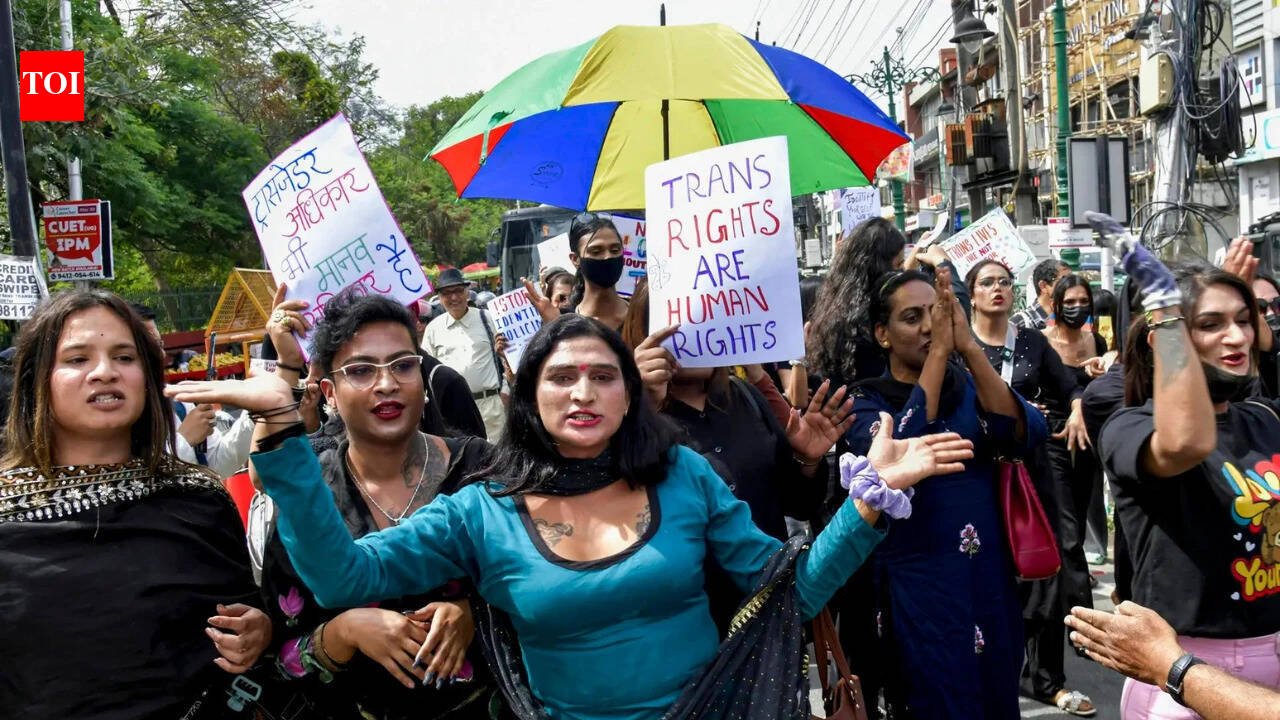
 The revised definition of “transgender” clearly excludes people with “different sexual orientations and self-perceived sexual identities.” A medical committee headed by the chief medical officer was set up. Going forward, district magistrates will issue transgender status certificates after reviewing the recommendations of “authoritative” medical committees set up by the central or state governments. Additionally, the DM may choose to seek help from a medical expert.While TG community members are exploring legal avenues to challenge the enacted amendments in court, they are wondering what will be the fate of the more than 32,000 TG certificates that have been issued to date based on self-perceived identities and pending approval. Abhina Aher, a member of the National Transgender Council, told TOI that the community is planning to take legal action as the bill violates the landmark 2014 NALSA judgment that affirmed the right of transgender people to self-determination. A visit to the National Transgender Portal linked to the Ministry of Social Justice and Empowerment website shows that the total number of applications received was 37,362. The portal shows that the number of transgender certificates issued so far is 32,660, of which 32,630 people have been issued transgender identity cards. As of Tuesday, as many as 5,833 applicants had not been found eligible and 4,794 applications were awaiting approval.In this context, young people like Akash (pseudonym) are a worrying group of people. Akash, a transgender from Charhi Dadri in Haryana who is undergoing counseling in Delhi and aspires to appear for the civil service exam, said he is scared of what lies ahead. “I got my TG certificate on March 18, but is it still valid? The amendment does not even mention trans men or trans women in the definition and takes away the right to self-identification.” So, what happens to me and other people in the same situation? Who will stand up for our rights and protect us from exploitation? asked Akash.The revised definition of “transgender” states that it includes persons with socio-cultural identities such as kinner, hijra, aravani and jogta, or eunuchs, or persons with intersex variations listed below, or persons born with congenital variations in one or more of the following gender characteristics compared to male or female development –
- main sexual characteristics
- external genitalia
- Chromosome pattern
- gonadal development
- production or response to endogenous hormones, or such other medical conditions.
The definition also includes “any person or child who, by force, inducement, inducement, deception or undue influence, with or without consent, is forced to assume, adopt or appear to assume a transgender identity by mutilation, castration, castration, amputation or any surgical, chemical or hormonal procedure or other means.”