
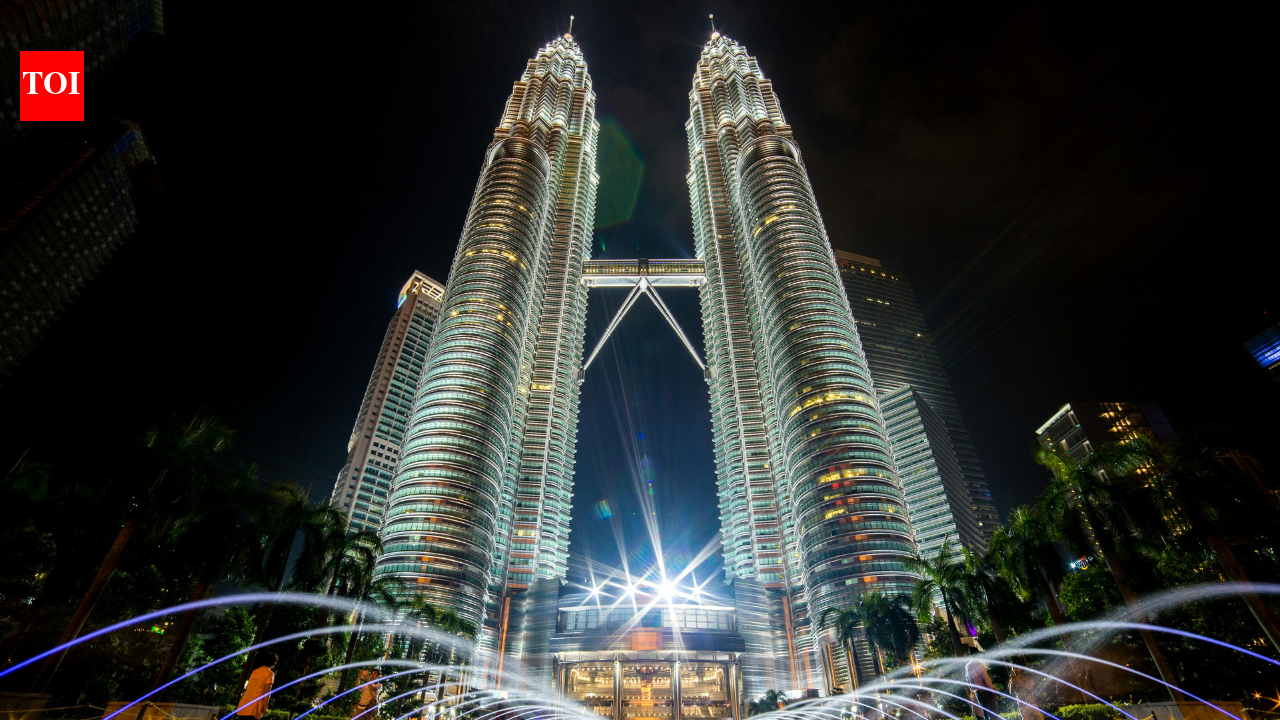
When Malaysia set out to build the Petronas Twin Towers in the 1990s, it adopted an unusual strategy that would become engineering legend. Rather than assigning the project to a single contractor, the government divided the work between two competing international consortiums, one led by Japan and the other by South Korea. What followed was a fierce, informal campaign driven by national pride, tight deadlines and high stakes. The competition spurred both teams to accelerate construction, ultimately helping to deliver one of the world’s most iconic skyscraper projects, which was completed in 1998 and briefly held the title of the tallest building on Earth.
Why Malaysia split this project between Japan and South Korea
Malaysia decided to zone the project out of practicality rather than spectacle. After an ambitious timetable was set, each tower was assigned to a different consortium, allowing construction to proceed simultaneously. A team led by Japan’s Hazama Corporation is responsible for the construction of Tower 1, while another team led by South Korea’s Samsung C&T is responsible for the construction of Tower 2. This parallel approach reduces delays and ensures that progress on one tower does not hinder the overall project.Beyond efficiency, however, this setup creates an environment where comparisons are inevitable. Two highly capable teams working side by side on an almost identical structure naturally inspires a sense of competition.
An informal competition has begun to take shape
Although there was no formal instruction to “race,” a competitive spirit soon emerged. Engineers and workers on both sides were aware of each other’s progress, and national pride became an unspoken motivation. Construction progress was accelerated, with continuous duty cycles and around-the-clock operations during key stages such as concrete pouring.The South Korean-led team eventually took the lead, reaching key structural milestones ahead of their Japanese counterparts. Despite starting a little late at some stages, they managed to complete Tower 2 at a slightly faster pace, a detail often highlighted in project reports.
Engineering Challenges and precision
Constructing twin skyscrapers of the same height and design presented significant engineering challenges. One of the most complex elements was the installation of the sky bridge connecting the two towers. This requires near-perfect alignment in height and position.Even minor differences must be corrected to ensure structural integrity and safety. Adjustments were made during construction to account for subtle differences, emphasizing the level of precision required for such a striking project.
Does competition really speed things up?
The idea that competition accelerates construction has become a popular narrative, and while it contains truth, it is often somewhat exaggerated. The main purpose of the dual federation model is to meet strict deadlines through parallel execution.That said, the presence of two competing teams may add extra motivation. The pressure to exceed performance, coupled with contractual obligations and potential penalties for delays, helps keep the entire project on pace.
record-breaking achievement
The Petronas Towers were completed in 1998 and remained the tallest buildings in the world until 2004. Beyond their height, they symbolize a new era of Asian engineering prowess and ambition. This project demonstrates how strategic planning, combined with world-class expertise, can deliver results on the global stage.Today, the Petronas Towers remain the tallest twin buildings in the world and an iconic feature of the Kuala Lumpur skyline.
The legacy of the twin towers
The story of the Twin Towers continues to resonate as an example of innovative project management. While the rivalry between the Japanese and Korean teams was never officially scheduled as a competition, it has become an integral part of the narrative surrounding the project.Ultimately, these towers represent more than just architectural achievements. They reflect how collaboration, competition and careful planning can be combined to create something lasting, turning bold ideas into record-breaking realities.