Dubai Crown Prince Sheikh Hamdan bin Mohammed Al Maktoum posts photo of lightning striking Burj Khalifa

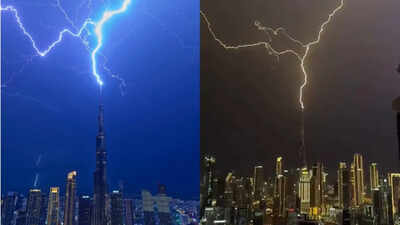
Recent thunderstorms and rainfall in the UAE have flooded social media platforms with dramatic visuals of lightning striking Dubai’s iconic Burj Khalifa, with many viewers asking the same question: How could the world’s tallest building survive a direct lightning strike?The answer lies not in luck but in cutting-edge engineering designed for moments like these. If you’ve also wondered what exactly happens when lightning strikes Dubai’s most famous skyscraper and why it’s completely safe, keep reading.
Dubai Prince Hamdan bin Mohammed Al Maktoum of viral Burj Khalifa photo goes viral
Sheikh Hamdan bin Mohammed Al Maktoum, Crown Prince of Dubai, Deputy Prime Minister and Minister of Defense of the United Arab Emirates, amid severe thunderstorms that swept across the city Instagram Deal with sharing the hot photos of the moment. Widely known as “Fazza”, he shared a striking photo of the Burj Khalifa illuminated by lightning and thunder, capturing a moment that immediately resonated on social media. “Moments worth stopping for #Dubai,” the prince wrote in the caption, punctuated with lightning and glitter emojis. The post went viral, combining Dubai’s iconic grandeur with the raw power of nature. More than just a photo, it reflects the city’s ability to transform severe weather into visual spectacles, where engineering marvels meet fleeting yet awe-inspiring moments.
Lightning strikes Burj Khalifa in Dubai, UAE: Why it’s not dangerous
The viral videos may look scary as lightning streaks across the sky and strikes the 828-metre-tall tower, but experts say that’s exactly what the building was designed to do. In fact, lightning striking the Burj Khalifa was normal, expected and well planned. Tall buildings naturally attract lightning, and the Burj Khalifa, as the tallest building in the world, actually acts like a giant lightning rod.
Science: How Burj Khalifa in Dubai, UAE, handles lightning
- There is a powerful lightning arrester on the top: There is a lightning protection system at the top of the tower. It detects electrical activity in the atmosphere, intercepts lightning before it propagates, and channels the energy safely into a building’s protective system. Think of it as a controlled entry point for lightning.
- “Faraday cage” effect: One of the most important safety features is the Faraday cage. The building’s steel structure, metal façade and reinforced frame work together to form a protective shell, channeling power to the outside rather than inside. This ensures the safety of those inside and ensures the electrical system is protected.
- Downline – Escape route: Once lightning strikes a building, the energy doesn’t stay there. It passes through conductive paths, metal frames, and is guided safely to the ground through specialized systems. This prevents fires, structural damage, and power surges within the building.
- Advanced grounding system: The base of the tower has a complex grounding system that absorbs electrical charges and safely disperses them to the ground. Without this, the energy has nowhere to go, making the system incomplete.
- Smart sensor that ‘predicts’ lightning: Even more advanced is the Burj Khalifa’s sensor-based system, which can detect atmospheric changes, identify lightning conditions and adjust electrode polarity to attract and control lightning strikes.
Simply put, buildings don’t just react to lightning; It can predict it and manage it. The recent erratic weather in the UAE has made lightning more visible due to intense storms and cloud accumulation, dust and humidity affecting the atmospheric charge, and increased rainfall events. This combination produces more pronounced and noticeable lightning, especially around tall buildings. As seen in recent footage, attacks are generally brighter, longer lasting and more photogenic, but not more dangerous.
What actually happened when the Burj Khalifa in Dubai, United Arab Emirates, was struck by lightning
While the visuals are striking, the real impact is minimal. When lightning strikes the Burj Khalifa, it is absorbed at the top and the energy flows along the exterior and dissipates to the ground within seconds. No explosion, no fire, no danger to occupants. In fact, the system ensures that the interior is completely unaffected.The Burj Khalifa is not unique in its mine protection, but it is one of the most advanced. All major skyscrapers include lightning rods, grounding systems and surge protection, but the height and prominence of the Burj Khalifa requires a more complex, multi-layered system. This makes it a lightning target and one of the safest buildings during storms. What makes these strikes so popular is not the danger but the spectacle. Recent clips show lightning lighting up the skyline, lightning striking tower spiers violently, and storm clouds enhancing the visual effect. As a recent report stated, even as the storm ripped through the city, lightning was “safely diverted through the tower’s system.” This contrast between visual drama and practical safety has fascinated audiences around the world.
Real risks during storms in UAE
While the Burj Khalifa is safe, wider weather conditions still pose risks of road flooding, reduced visibility, traffic accidents and flight disruptions. Authorities often advise residents to:
- Avoid unnecessary travel
- Stay indoors during storms
- Follow official weather updates
This is because the danger is not the building, but its surroundings. Lightning strikes are a reminder of the unpredictable, dramatic and awe-inspiring power of nature, and of human engineering’s ability to predict and control that power. Burj Khalifa is located at the intersection of the two. Yes, lightning can strike the Burj Khalifa, but no, it poses no threat because behind every dramatic flash there is a system designed to capture it, control it, and safely return it to Earth.