
‘Insufficient evidence’: SPL Delhi court acquits former MP Darda, son and lawyer others in coal ‘scam’ case


NEW DELHI: A special Delhi court on Friday acquitted former Congress MP Vijay Darda, his son Devendra, former coal minister HC Gupta and others in the coal block allocation case, concluding a trial that lasted more than a decade after finding the evidence was “grossly insufficient” to prove charges of cheating, conspiracy or misconduct.The case stems from the allocation of Bandar in Maharashtra and resulted in the first CBI chargesheet in the larger coal block dispute since the Congress-led UPA came to power. The FIR was filed in 2012 and the chargesheet was filed in 2014.
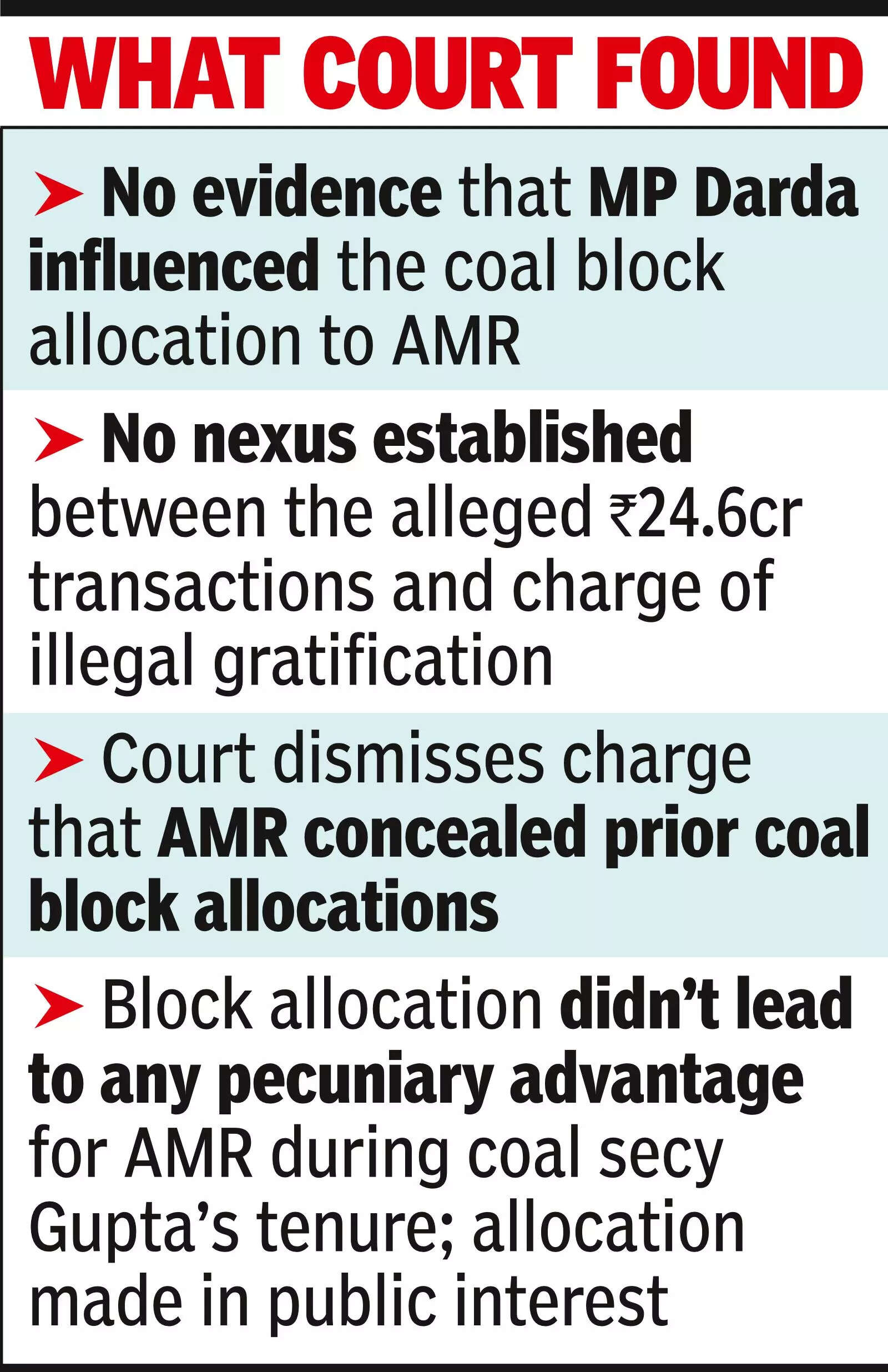
Justice Sunana Sharma found there was no evidence of criminal conspiracy, noting that the case was based on speculation and lacked evidence of a “consensus” or illegal agreement. Other companies that received approval include AMR Steel Private Limited, which acquired the block in Bandh, Maharashtra, its director Manoj Kumar Jayaswal and two others. Advocate Mudit Jain appeared for Jayaswal, Dardas and AMR, while advocate Rahul Tyagi represented Gupta. Sharma submitted that too little material has been recorded to conclusively establish any of the essential elements, namely, deception, inducement, dishonest intention or cheating under Section 420 of the IPC.The CBI alleged that AMR conspired with Gupta to submit false information to the screening committee of the Union Coal Ministry to secure allocation. According to CBI reports, Vijay, then a member of the Lok Sabha, wrote to various departments and allegedly reiterated false statements to influence the allocation process and received illegal remuneration of Rs 24.6 crore.Strictly adhere to the rule of not naming survivors: SCThe SC said: “Clearly, the intent of this section has been ignored in these proceedings. The survivor’s name is used the same as that of any other witness and is used freely throughout the record. This practice must be opposed in the strongest possible terms. In fact, this Court had earlier also noted that the mandate of the provision was not complied with”.The court said a copy of the judgment will be sent to all high courts to ensure strict compliance with the Supreme Court order.“This is a long-standing position in the law but it is not adhered to. It is argued that the main reason for this is the general indifference and perhaps even lack of awareness of the deep shame attached to such criminal conduct by the lower courts,” the Supreme Court said.The Supreme Court, while convicting the accused and setting aside the acquittal order of the Uttarakhand High Court, said the court must not place undue importance on minor differences.“An honest witness may make honest errors or omit inconsequential details, and this normal variation should not lead to a blanket rejection of evidence. However, when omissions or contradictions relate to material facts that form the basis of the prosecution’s version, they are material and may create reasonable doubt… We can observe that the approach adopted by the High Court is to try to find holes in cases that have stood the test of cross-examination. The prosecutor has clearly identified the defendant and made it clear that he forced himself on him,” it said.